


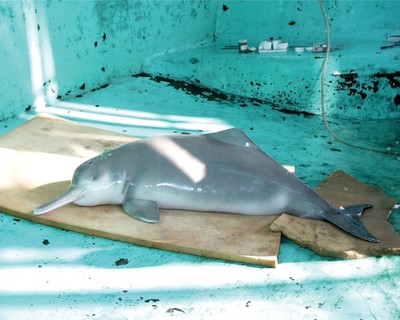
Three scientists from the Southwest Fisheries Science Center in La Jolla dedicated a month and a half of their lives to determine whether the white river dolphin, or baiji, is extinct.
But the researchers weren’t sitting around libraries, noses pressed to books. Instead, Barbara Taylor and Robert Pitman, both doctors of conservation biology, along with Dr. Jay Barlow, spent more than half a year hunting for the cetaceans in their natural habitat of China’s Yangtze River.
“The survey was from the Three Gorges Dam all the way down to the opening where the river meets the Pacific Ocean “” about 1,000 miles of river we looked at,” Pitman said from a conference room at the center in La Jolla, to which he had just returned the previous day from China. “We used two boats and covered the river twice. We saw no Baijis.”
One of five species of river dolphin in the world, the baiji had been around for more than 20 million years and was one of the world’s oldest species, according to the Baiji.org Foundation.
The Yangtze River expedition, which included 30 people from six different countries, was under the direction of the Institute for Hydrobiology in Wuhan and Swiss-based Baiji.org Foundation.
All three La Jolla scientists ” as well as the majority of those on the expedition ” agree that the baiji is most likely extinct.
“We may have missed a few, but there is no way that they could exist and survive in that river,” Pitman said. “There is too much economic traffic.”
As the third largest river in the world, the Yangtze is China’s superhighway and is a major source for interstate commerce, according to Pitman. During the expedition, the group sighted close to 17,000 100-foot-long vessels on the river.
But a large volume of boat traffic is only one of the reasons attributed to the disappearance of this unique animal.
Although strict fishing laws have been established in China, along the Yangtze these laws are rarely enforced, and illegal practices, such as fishing with rolling hooks, are still present, according to Pitman.
Rolling hooks, constructed of a series of hundreds of small and extremely sharp pieces of metal looped around a long wooden dowel with rope, are placed on the bottom of the riverbed, where baiji often congregate. The scientists took many photographs of the devices and even brought one back from the expedition.
Gillnets are also major contributors to dolphin deaths, according to Taylor. The fact that baiji are now extinct, in all probability, is significant to scientists and should resound with the entire world, she pointed out.
“This is the first species of whale or dolphins and other large mammals that have gone extinct by the hand of man,” Taylor said. “This is just something that happened on accident ” all the others were killed for hunting purposes.”
Taylor and Pitman were involved in a similar survey off the southern coast of California to track down the Vaquita dolphins, which are thought to be critically endangered and nearing extinction.
Scientists estimate that 250 to 300 of the Vaquita are left. Gillnets are again thought to be responsible for the reduced population, according to Taylor.
“Gillnets are everywhere and everything that gets caught in them die by hundreds of thousands,” she said.
Taylor and Pitman have a heightened awareness of many marine creatures that face a serious threat of becoming extinct, and believe that expeditions, such as the ones they’ve participated in help to increase that awareness worldwide.
“There is an environmental debt that we are building up and it’s going to come due,” Pitman said. “The public has become weary of scientists warning of this because extinction hasn’t really happened yet. But now it has, and maybe by hearing about this people will begin to wake up.”
The Southwest Fisheries Science Center is a branch of the National Oceanic and Atmospheric Administration, a service organization that is committed to the conservation and management of marine wildlife and other resources.
For information about the baiji dolphin, visit www.baiji.org.


