


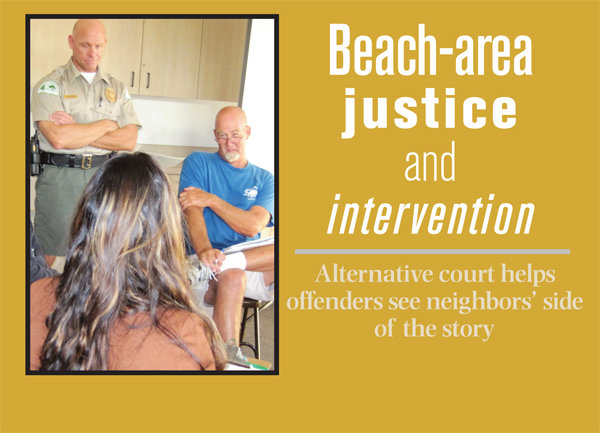
Alternative court helps offenders see neighbors’ side of the story “If you wouldn’t do it in your own community, don’t do it in ours.” That’s the message behind the alternative Beach Area Community Court (BACC), which is nearing the end of its fifth year in Mission Beach and Pacific Beach. The beach area, including Mission Bay Park, is one of 10 demonstration sites in the country participating in the so-called “restorative justice” program. It offers eligible offenders the option of resolving quality-of-life misdemeanors without having to pay a fine, go to court or face criminal charges on their records. Meanwhile, offenders have the chance to make restitution in the community where the offense was committed. The program, a collaboration of Discover Pacific Beach, the City Attorney’s Office and the San Diego Park and Recreation Department, emphasizes “education and making amends.” Offenders must attend a two-hour learning program at the Pacific Beach Recreation Center on Diamond Street, which includes discussions with police officers, park rangers, a deputy city attorney and community residents who volunteer their time. There is also a presentation by a registered nurse on the potential dangers of excessive alcohol and smoking. Offenders are required to give four hours of community service the following weekend. Offenses that might qualify for BACC include having open containers of alcohol in public, glass on the beach, fighting and vandalism, ignoring fire-ring violations, urinating in public, smoking in non-designated areas and failure to follow the rules for dog restraints. To be eligible, offenders cannot have any felonies or violent misdemeanors on their records or any outstanding warrants. Participation is voluntary and only offenders who are cooperative and respectful with the police or park rangers may participate. Program administrators say it’s a privilege to attend the BACC, which is offered just once to each offender. Because the original $200,000 federal grant has run out, the program now charges participants a $40 registration fee. “It’s a win-win for everyone,” said Sara Berns, executive director of Discover Pacific Beach. The program gives community members a place to explain what it’s like to live in this community, while it gives offenders the chance to resolve their citations, learn from their experience and share local rules and regulations with friends, said Berns. Before the beach-alcohol ban and until people became used to it, there were up to 40 program participants a week in busy summer months. Now, an average of about 20 attend each Beach Area Community Court meeting — either monthly, twice a month during the summer or every other month in winter. Touting the program’s success, Berns points out that out of thousands of people who have participated in the program, only two had re-offended as of last year. Among the 23 offenders who attended the last BACC meeting was 21-year-old Rogelyn, who admitted, “I was partying with a fake ID two months before I turned 21.” Colin, 19, said he got caught “doing my business” outside. So did 21-year-old Chelsie, who said there was a long line at the bar’s bathroom and she couldn’t wait. “I broke a sign on an apartment building … I don’t know why,” said a young vandal. Lauryn, a 24-year-old who already had a DUI on her record, claimed she was busted after she “grabbed my friend’s beer off the roof of the car just to throw it away.” She said community service is much better than a suspended license. Besides, the Lakeside resident said, “At least community service is at the beach.” “The cop who gave me the ticket was really cute,” she added. “And I was nice and cooperative.” Lauryn and the other recent participants fulfilled the community-service requirement by cleaning up trash at Vacation Isle. Community service varies for each group, and has included painting park rules on trash cans, sweeping the boardwalk and sidewalks, weeding tree wells along Garnet Avenue and removing graffiti. Speakers at the recent BACC meeting talked about everything from the ban against burning pallets to leash laws. Dogs must be on a leash at the beach and at Mission Bay Park before 9 a.m. and after 6 p.m. during the summer. They are prohibited from even being at either place between 9 a.m. and 6 p.m. That includes sitting in parked cars in Mission Bay Park parking lots. Geoff Hasenauer, a Mission Bay park ranger and former lifeguard who grew up in Pacific Beach and Bay Park, spoke about the importance of preserving the community’s lifestyle. “PB used to be a family community … but it’s been out of control,” he said. Hasenauer added that the “crowd mentality” — doing the wrong thing because everyone else is doing it — is what hurts the quality of life at the beach. “It’s time to grow up and make good decisions,” he said, admitting that he wasn’t the perfect kid, either. Police officer Ben Douglas said his job “is solving a problem before it becomes a significant one. (Locals) don’t particularly like someone trying to get into their house because they don’t remember where they live.” Asked about so-called ticket quotas, Douglas said simply, “It’s illegal in California to have quotas.” Cheryl Wooten, a registered nurse, showed graphic slides of people who have ended up in the hospital as a result of bad habits. “Alcohol and tobacco kill more than 50 times the number of people killed by cocaine, heroin and other illegal drugs,” Wooten said, and then asked the smokers in the audience to raise their hands. About half did. Meanwhile, offenders listened intently to the presentations, glad to get off with just two hours of talk and four more of community service. “I would recommend this to others because I got to do something productive and give back to the community,” said one participant in a survey after the event.


