


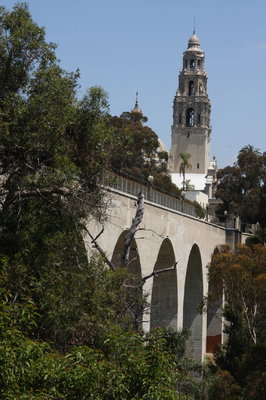
Plans to clear cars out of Balboa Park’s Plaza de Panama and turn it back into a pedestrian plaza in time for the centennial celebration of the 1915 Panama-California Exposition are currently being prepared for submittal to the City of San Diego. The overhaul, however, brings with it a flurry of contentious debate. After months of public testimony, the Balboa Park Committee, which serves in an advisory capacity to the mayor and city council on issues pertaining to the park, will consider design alternatives and refine various elements of different proposals that will be put through the environment review process by the city’s Development Services Department. Under consideration is a proposal by Irwin M. Jacobs, philanthropist and cofounder of Qualcomm. Jacobs’ plan calls for construction of a 400-foot-long, 40-foot-wide two-way bypass road and bridge to divert traffic through the park. The bypass road and bridge would abut the historic Cabrillo Bridge, wind around the Museum of Man and end at a proposed multi-story, 785-space parking garage behind the Spreckels Organ Pavilion in the existing Alcazar parking lot. Jacobs’ proposal had drawn stiff opposition from historical preservation societies throughout the United States, including Save Our Heritage Organisation (SOHO) in San Diego. Bruce Coons, executive director of SOHO, said the proposed improvements are more akin to something you would want to do for a shopping center instead of a National Historic Landmark (NHL). Coons said Jacobs’ plan was disgraceful, calling it the worst project that has been proposed for Balboa Park in 50 years. He expressed doubts it could be completed in time for the centennial celebration in 2015 and possibly also the 250th anniversary of the founding of San Diego in 2019. “San Diego doesn’t really need this,” he said. “There’s nothing to like about this plan except for getting the cars out of Plaza de Panama.” Estimated to cost about $33 million, Jacobs’ plan, which has been endorsed by Mayor Jerry Sanders, 26 park museums and the zoo, would be paid for through a combination of philanthropy and private money from large and small donors, with the remainder coming from revenues generated by paid parking. Lead designer Mark Johnson of Civitas, a Denver-based land-planning and landscape architectural firm, said the basis of the NHL designation is not just the historic Spanish-style buildings, but the composition of structures and landscape. He said restoring the Plaza de California, Plaza de Panama and Esplanade back to their intended use will dramatically improve the historic preservation of the park and greatly increase access, while creating 6.3 acres of space for pedestrians. According to Johnson, traffic and pedestrian counts conducted over a six-month period revealed that about 7,000 cars pass through the plaza every day. He defended the need for a bypass bridge, citing the need for space for pedestrians. “It’s a very large challenge to design something that’s in a place that so many people love for so many different reasons,” Johnson said. “Because there are so many different ideas, everyone can’t get their ideal solution. It’s all about balance, and we feel that the 6.3 acres of park is a very good tradeoff for some of the concerns that people have.” Betty Peabody, a 42-year volunteer in Balboa Park, said opening up the park and making it more pedestrian-friendly is something she has wanted for many years. She characterized the partnership between Jacobs and the mayor as “two legs of a three-legged stool to do some things the park deserves and has needed for quite a long time,” adding that good infrastructure, traffic patterns and connectivity are necessary in order to do what’s best for the greatest number of people and for the longest period of time. “Our goal is to leave a legacy that will last for the next 50 to 100 years like the forefathers did who had such foresight and left it for us,” Peabody said. “We want it to be all things to all people and guarantee that it will continue to sustain for future generations.” Jim Hughes, chairman of the board of the Friends of Balboa Park, said the organization remains neutral on issues affecting the park, though there are differences in personal opinions among board members regarding the plan, ranging from strongly in favor to strongly opposed. “This matter is before the Balboa Park Committee and they alone will decide what is or is not in the scope of the Plaza de Panama project,” Hughes said. “The Friends of Balboa Park will go along with whatever their conclusions are.”


