


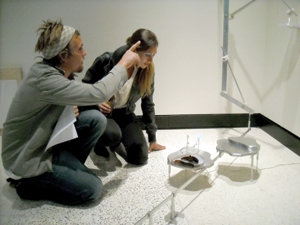
When confronted with divergent material from outside sources, professor Alan Beals used to defend his lack of ability to integrate them by saying, with a slight German accent, “Well, my water tight compartments are water tight.” That is the case with most of us and with academia. We always seem to have to keep our apples separated from our oranges, our fields and areas of inquiry separate and distinct. But not so at Calit2 (California Institute for Telecommunications and Information Technology) at the University of California, San Diego, where they want people from divergent fields with divergent ideas to interact. To ensure this, the university hired someone just to make connections among the people who work there so “the people on the second floor knew what the people on the third floor were doing.” At Calit2, the vision is to advance the “understanding and appreciation of the dynamic interplay among art, science and technology.” To this end, along with the scientific research, they have a state of the art theater with state of the art sound and video, and an art gallery on the first floor which they hope will reflect the “nexus of innovation” implicit in their vision. On April 2, the Calit2 art gallery opened a “green” or sustainability-themed art exhibit by Sabrina Raaf, which was curated by Steve Dietz, founder of Northern Lights.nm. The exhibit was named “Light Green Light: Toward Sustainability in Practice,” and it will run until June 4. Sabrina Raaf is a Chicago-based artist who custom builds robotic sculptures and site-specific installations, with built in experiments, addressing issues of sustainable practice, the construction of social spaces and modular green architecture. Raaf’s work in experimental sculptural media and responsive environments and social spaces have been shown all over the world. She was educated at The School of the Art Institute of Chicago and is currently an associate professor at the School of Art and Design at the University of Illinois at Chicago. “I build interactive machine-based installations capable of reading their environment,” Raaf said. “My works are designed to heighten people’s awareness of the social space they share … My goal is to define ways in which generative and responsive environments might provide useful information to a community.” Five of Raaf’s electronic and responsive artworks are in this exhibit. Most are best viewed bending over or on hands and knees. “Translator II: Grower” is a small vacuum cleaner-shaped robotic sculpture that measures carbon dioxide inside the gallery, then graphs the measurements as green grass of different lengths on the wall as it moves down along it. “Icelandic Rift” involves scale model electronically-powered mechanical systems that represent future visions of agriculture and mining in zero-gravity environments. “Light Green Light” is a lamp that folds into a tent, while “(n)Fold” is a dew harvester and solar cooker, and “Meandering River” is a sculpture made of thermal screen material folded into patterns that model meandering river mathematics. Gallery hours are Mondays through Fridays from 11 a.m. to 5 p.m.


