


It was the best of bathrooms, and then it was the worst of bathrooms
Michael Good | House Calls
All it took was a little water in the wrong place and a short conversation with her contractor to turn Dee Quashnock’s spectacular art deco bath into a major headache. Long story short: the only way to repair structural damage in the walls was to remove the floor-to-ceiling tile that made her bathroom so spectacular. She had to destroy her bathroom in order to save it.
In the annals of old house owners, Dee’s dilemma is hardly unique.

In the 1920s, literally thousands of art deco bathrooms were built in Spanish style houses in Kensington, Talmadge, El Cerrito, North Park, South Park and Mission Hills, not to mention Point Loma, Normal Heights, University Heights and Marston Hills.
Like Dee’s, the walls were coated with waterproof, easy-to-clean, colorful tile in maroon and black, pink and red or yellow and brown. And like Dee’s, whenever something went wrong inside those walls, the tile had to go. The coup de grâce usually didn’t come from water inside the bathroom, it came from leaking roofs, leaking windows and leaking pipes that brought water inside the walls, where it slowly did its work, aided by termites, fungus and mold.
But water isn’t the only enemy of Jazz Age bathrooms. They have the 21st century American homeowner to contend with, and his or her accomplice in architectural crime: the home décor reality show and the designers who dream of someday being on it. Due to a number of factors – ignorance of history, ego, America’s color-adverse, fifty-shades-of-beige esthetic – designers tend to confuse the two eras of early 20th century bathroom design (and, seriously, there are only two of them, so it shouldn’t be hard to keep them apart).
A brief history of the bath: for 99.99 percent of human history, bathrooms didn’t exist. Finally, at the turn of the 20th century, properly vented toilets became widely available, along with municipal water systems that provided adequate water pressure and sewage disposal. But suspicions about “bad air” in the bathroom and the dangers of bathing prevented the whole concept from catching on. By 1920, only 20 percent of American homes had flush toilets.
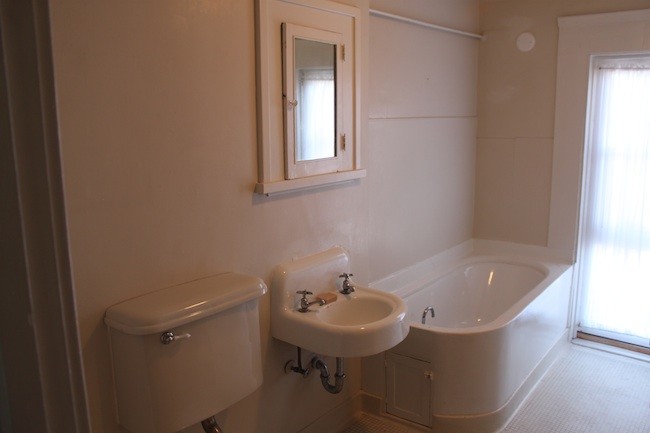
Prior to the World War I, most bathrooms were relatively sedate. They were usually white, with a white porcelain toilet, sink and bathtub, white hexagonal tile on the floor and subway-style tile on the walls. There were small variations, but most houses, regardless of size or cost, had remarkably similar bathrooms. They were utilitarian places, like operating rooms, where something mysterious and possibly dangerous happened. Cleanliness was thought to be an upper-class preoccupation, and of little real value.

That all changed in 1918 when a third of Americans came down with the flu. About five percent died. The pandemic affected mainly young adults. Women were hit particularly hard, especially pregnant women. In 13 studies conducted during the flu pandemic, mortality among hospitalized women ranged from 23 percent to as high as 71 percent. We didn’t need any further convincing that there were germs in this world, and that they had to be stopped. The first line of defense was the bathroom.
Up until this point, what went on in the bathroom had been a private matter. Then Hollywood opened the door. But rather than emphasize the clinical, sanitary quality of the bathing experience, Hollywood made it fun. Movies and movie magazines showed stars engaging in all sorts of glamorous activities in the bath: reclining in tubs, vamping in front of vanity mirrors, flouncing about in dressing gowns. While wedding dresses turned white in the ‘20s, bathrooms got color. The bath became a place to escape, relax and rest, not just to perform sanitary ablutions.
The 1920s was a crazy, contradictory time for women. They got the vote in 1920. By 1930, one-in-four were working outside the home. A number of timesaving appliances were introduced during the Jazz Age, from vacuum cleaners to clothes washers, garbage disposals to refrigerators. But the amount of time women spent on housework didn’t really change. They were still spending 50 to 60 hours a week, but now they were doing the work themselves, rather than directing servants, tradesmen and delivery guys.
If they were going to have to clean the bathroom themselves, they were going to make it their own.
So not only did baths become more fashionable, they became more restful as well, outfitted with benches to sit on while you dressed, better lighting and mirrors, alcoves for showers and tubs, separate rooms for toilets, additional sinks and heaters, and even bidets and floor-mounted foot-washing basins. Cabinets popped up everywhere, topped with tile or linoleum, so makeup, toiletries and perfume wouldn’t damage the furniture.
Built-in vanities and separate dressing areas began to appear as well as multiple cupboards with more storage for cosmetics, perfumes, shaving supplies and electric curling irons. In the ensuing century, the devices and doodads have only increased exponentially, like a flu virus. Today, it takes discipline to squeeze a modern bathroom into an antique house and still keep some sense of integrity, much less get your bathroom eras right.
When I met Kristin Westerman and Linda Bright a few months ago, they were keen to preserve the architectural elements that made the living and dining rooms of their South Park Spanish Revival bungalow so distinctive. But the bathroom? Not so much. Unlike many 1920s houses, there was nothing art deco about the design of their interior. If anything, it had a sort of classical, Greek revival feel to the square, fluted red gum columns in the living room.
So when they remodeled their bathroom a few months ago, Kristin and Linda kept that classic feel. They didn’t try to replicate the all white porcelain bathroom of the 1910s. Like their bungalow, which is small but high style, their bath is compact and thoughtfully designed, with taupe-colored, matte horizontal tile on the walls.
They’d replicated the original medicine cabinet, and kept the sink, toilet and shower in their original locations. Best of all, the bathroom reflected their – and their house’s – personality. And, as Kristin was quick to point out, “it came in exactly on budget.”
As for Dee, previous homeowners had already made some rather regrettable changes to her house, so she was determined to hold the line in the bathroom. She found a manufacturer to replicate the tile, matching the size and color, and she had it installed in the original pattern. When I saw the bathroom after it was done, I felt as if I’d stepped in the way-back machine. It was a déjà vu remodel. And sometimes that’s the best kind.
—Michael Good es contratista y escritor independiente. Su empresa, Craftsman Wood Refining, restaura carpintería arquitectónica en casas históricas de San Diego. Es un San Diegan de cuarta generación y vive en North Park. Puede comunicarse con él en [email protected].


