


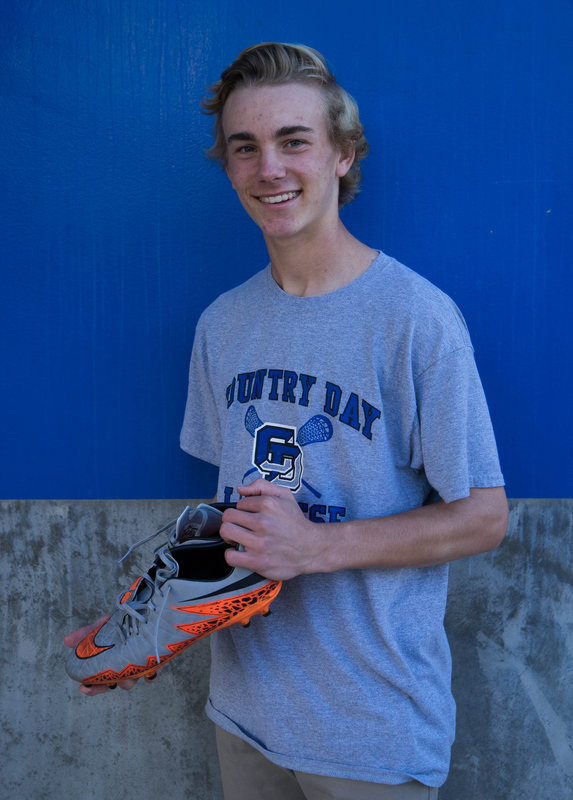
Wynton Bastian, a promising lacrosse player at La Jolla Country Day School, has faced two instances when his interpersonal skills weren’t up to par: first when his family moved back to Germany four years ago and his German proved faulty; and second when the Bastians relocated from Hamburg to San Diego and Wynton’s subpar lacrosse skills left him sitting on the bench. In the first case, Bastian’s father Helge, a well-traveled synthetic biology scientist, moved the family back to its native land: himself, Bastian’s mother Elke and the 11-year-old Bastian, born in Dusseldorf. Bastian’s spoken German was lacking. “I grew up speaking German,” says the 14-year-old, who has already resided in three countries for almost five years each. “I still speak speak it at home with my parents all the time. I used to be kind of fluent in French,” he adds, but that has become rusty due to lack of use. “Germany was a big change (after living elsewhere). I had to get my German back up. We were speaking it in our home, but not as much. My school in Hamburg was an international school, so we spoke English in class. But we had a German class, so I got my German skills up through that.” Amid his fair features and tousled hair, looking like he’s straight off the beach, he chuckles at us monolingual Americans. “In Europe, the people speak multiple languages,” he says. “In the U.S., people are so amazed when you speak multiple languages.” Meanwhile, he’s following in dad’s sports footsteps, as the latter played soccer for a German national team . Accordingly, he says, “I feel like I’ll follow my dad in doing something related to science. “He supports me in whatever I do. I could quit lacrosse some day and switch to baseball, and he would say, ‘OK.’” The second instance occurred in the Bastians’ many switches in residences, this one from Hamburg to San Diego a year ago. Bastian lived in Dusseldorf until he was 3. The family then spent five years in Geneva. A move to St. Louis followed and lasted three years before the return to Germany. Bastian had begun picking up lacrosse in St. Louis in the fourth grade, taking to the sport because “It’s fast. It was something new. I’d never heard of it. It’s interesting, and I fell in love with it.” He now plays year-round, on club teams and in the coming spring for the Torreys team at Country Day. But his skills in lacrosse didn’t measure up to the level played here, as he had played only in Europe. “I kind of sucked,” he laughs. “I wasn’t used to the way they make teams here. There (in Europe), they have club teams. Everyone who goes out makes the team. No one is cut. Here, you try out and can get cut.” Bastian was a little shocked by the situation. In Hamburg, his parents signed him up for a national team when he was only 11. The advantage was that he had to compete against older players. He was so good in comparison with his teammates that he was named a captain and continued in that role the rest of his time in Hamburg. But in San Diego, the skill level of players was much higher. His solution: Begin improving his stick skills through hard work. “I started working on shooting before school and after,” he says. He worked with Deane Mellor, Country Day’s lacrosse associate head coach, who helped him considerably during his eighth-grade year at LJCD. Through his math teacher, lacrosse head coach Rory Hyland, he was invited to practice with the high school varsity despite still being in middle school. “Eventually, I made a club team, Mad Dog. I still play for them.” The athleticism he brings to lacrosse includes his agility and foot speed. Also, “I have a hard shot,” he says. He plays “middie” (midfielder) and attack, which is offense. And if his name sounds familiar, that’s because it is. He is named after trumpet great Wynton Marsalis and Wynton Rufer, a star soccer player from New Zealand. Though he plays soccer in addition to his number-one sport, lacrosse, the only musical note he plays would seem to be his favorite tune on his phone.


