


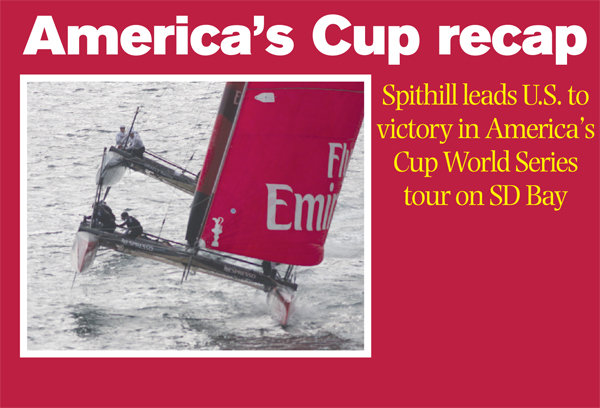
There’s something to be said for a “home port” advantage. Jimmy Spithill, who spent his younger years charting San Diego’s waters, skippered a U.S.A 45-foot Oracle catamaran to victory over the French team in the America’s Cup World Series tour this month on San Diego Bay. It had figured to be a sail-off final with the internationally-experienced New Zealanders. Instead, the kiwis settled for third place after beating Sweden. Then, Spithill closed the final weekend by taking the full-force Fleet race. The Oracle team might be remembered, too, for snapping New Zealand’s string of three wins with a breakthrough triumph in the America’s Cup for 72-footers in 2010. It appears they’re still on a roll. The World Cup was a spectacle, unlike other weekends when billowing white sails are prevalent in varied competitions on the waters of San Diego Bay. For the average shoreline spectator witnessing this event for the first time, a rule book and assistance from a learned observer might have been necessary. Tactical turns, errors and penalties imposed along the course might have been beyond novice comprehension. The seamanship of those scrambling, acrobatic helmeted sailors keeping things in balance was entertaining theater. The AC45 boat was designed by the Oracle racing design and engineering team. At task was designing a boat that would not only meet the racing criteria, but could also fit inside a 50-foot container, which is the shipping vessel for the racing world series. Although dangerous, promoters of the AC World Series and the America’s Cup could not have orchestrated a more effective promotional stunt. The AC45s will compete in locations around the globe. “I think this series is critical to the future of the (major) America’s Cup,” said Australian Iain Murray, regatta director and CEO of America’s Cup race management. “Sailing in the best of times is not an easy sport to understand,” he said. “For us to succeed, we must present an understandable and exciting sport on TV. We’ve got to look at how we bring the race courses into the public arena.” The nine days of time trials, eliminations and fleet maneuvers were pleasing to the eye as a capsuled introduction to what it will be like when the 72-foot boats compete on San Francisco’s bay for the major-league America’s Cup in 2013. The curious came to Broadway pier to get a close-up view of all the activity, watching these skeleton-like boats drift close by. Decisions will be made this month whether the World Series will return to San Diego next year, according to a racing spokesperson. Organizers said there is a need for more international racing interest, possibly from Australia and Italy. Korea, China and Spain remain in a learning curve. Even winning a preliminary race was a step in the right direction for a Chinese team that had no Chinese nationals aboard. They plan to compete in the America’s Cup in the future with “Chinese sailors on a Chinese-built boat.” The hard-wing catamarans being sailed in the world series tour are high-tech, high-performance beasts to handle. By the time the actual America’s Cup comes around, the event will be sailed in even more demanding 72-foot catamarans. And for that extra home port advantage, the Oracle boats are based and train not far away from the San Diego Bay bridge.


