


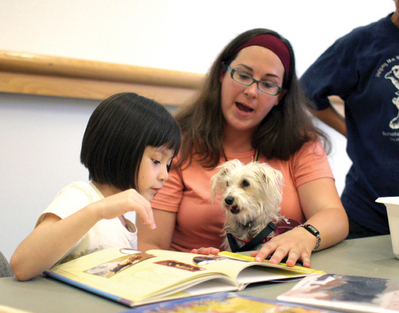
Twice a month, La Mesa resident Shirley Colman takes her dog Davy, a sweet-tempered, mellow apricot-and-white American cocker spaniel adopted from an animal shelter, to the La Mesa Branch Library for children to read to him. Davy is one of three certified pet therapy dogs who regularly visit the library to help children read. Most of the program participants have struggled with their reading. Having a nonjudgmental pet listen while they read helps them gain confidence in their reading and language skills while they bond with companion animals. Anna Hartman, children’s librarian at the La Mesa library, explains that children often select books with dog characters in them. “Sometimes the kids show the pictures to the dog and choose books they think the dog will like,” she says. Colman got involved in pet therapy programs about ten years ago with her late dog Duffer, who was certified through Therapy Dogs International (TDI). She credits Duffer with easing her father’s final illness. “We helped my father die. I saw how good he [Duffer] was with my dad and how he made him more comfortable,” she says. Having observed firsthand the benefits and special “canine medicine” therapy dogs can bring to patients in need of comfort and children in need of encouragement to learn, she knew soon after she adopted him that Davy had the right temperament and instincts to be an effective therapy dog.?”A (therapy) dog must be friendly, must be good with every age person, from children to almost vegetative to the end-of-life person. The dog must show compassion and show it wants to help. It must outwardly behave so as to want to help the client, whatever the needs, and must also have all the basic commands down pat,” Colman explains. While there are 13 separate organizations in San Diego County that evaluate and certify dogs and their handlers to serve as therapy dog teams, all have slightly different requirements. Colman chose TDI because she liked the flexibility it offers volunteers to select the facilities they want to visit. When she contacted TDI to arrange for Davy’s certification, she discovered she would need to travel to Los Angeles or Orange County for a testing session because the organization had no presence in San Diego County.?Instead, she arranged for TDI evaluator Mary La Crosse of Fountain Valley, Calif., to come to La Mesa for a weekend in August of 2008 to evaluate and certify 23 new canine teams. The successful dogs also received the American Kennel Club’s Canine Good Citizen temperament certification, required for dogs to work as therapy dogs. The testing proved so successful that Colman and La Crosse agreed to conduct TDI sessions every few months in La Mesa until San Diego County has a qualified TDI evaluator to meet the demand.?With so many new volunteer teams, San Diego now has a “virtual” TDI chapter linking volunteers and the many facilities requesting therapy dog visits.?Pet therapy programs, whether they “employ” dogs or small animals such as rabbits, guinea pigs and rats, as the San Diego Humane Society’s (SDHS) Pet-Assisted Therapy (P-AT) program does, are volunteer-driven and have similar goals. “We do this because we believe in the program, whatever the organization. We’re trying to do the same thing: bring comfort, cheerfulness and happiness to people who don’t get it any other way. Animals can do what medicine cannot,” Colman says. Judith Eisenberg, who coordinates SDHS’s P-AT program, agrees that the program’s volunteers are motivated by the desire to help others. P-AT volunteers take dogs and small animals into medical, convalescent and retirement facilities, as well as homeless shelters, transitional housing and specialized public school classes and libraries.?Facility staff members report that previously unresponsive patients have often reacted with a smile to a visiting pet. One pre-teen girl at a psychiatric hospital developed such a bond with a P-AT bunny that she later adopted it and was able to avoid future hospital stays.?”It doesn’t take a lot of time to make a difference in someone’s life and give them something normal. The volunteers get a lot of joy out of bringing pleasure to others. Most people we visit can’t even take care of themselves,” Eisenberg says. For more information about TDI’s evaluation and registration programs, as well as upcoming dates, visit www.tdi-dog.org, or email [email protected]. For information about SDHS’s volunteer P-AT or to volunteer, visit www.sdhumane.org or call (619) 299-7012, ext. 2271.


