


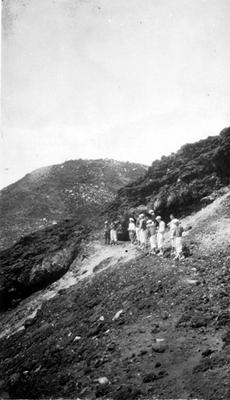
The summer of 1930 was a particularly adventurous one for three young La Jolla men. It included a visit to the Imperial Palace and the Forbidden City in Peking, climbing Mt. Fuji, a tour of Confucius’ Temple in Peiping and taking in any number of odd sights in Manchuria, Korea, Japan and Hawaii. Their adventures were features of a “Hands Across the Pacific” tour sponsored by the California State YMCA. The La Jolla youths going on the long summer journey to the Far East were Bob Larimer, Jack Haskell and Joe Gunsaulus — all members of the local Y. While the trip no doubt was memorable to all involved, it was particularly so to Gunsaulus, who kept a comprehensive account of the voyage and sights, recording events and details in a large scrapbook upon his return to the family home on Ludington Place. (Gunsaulus later pursued a lifetime career as a landscape architect in La Jolla.) His scrapbook was recently accessioned by the La Jolla Historical Society as a gift to be added to the archives from an anonymous donor. It includes personal photographs, postcards and numerous pieces of memorabilia including ships’ menus, hotel brochures, maps and printed instruction pamphlets about how to properly conduct oneself in the Orient. All are particularly vivid reminders of how far the Far East was in the summer of 1930. Joining a group of about a dozen YMCA members from around the state, the young men sailed from the San Pedro harbor June 9, 1930, on board the NYK liner SS Taiyo Maru. They returned home Aug. 25, 1930, aboard the SS Chichibu Mara, also docking in San Pedro. Arriving and ending their Far Eastern trip in Yokohama, Japan, they traveled through the Orient primarily on trains. Among the major cities visited were Seoul, Osaka, Tokyo, Peiping, Shanghai and Kobe. Stops along the way included schools, cultural institutions and department stores — besides all of the celebrated landmarks such as the Imperial Palace. Gunsaulus took black-and-white snapshots throughout the trip and pasted them in the scrapbook for posterity using the proverbial album black corners. Often, he recorded a Far East that seemed isolated, serene and rural — ancient mountain temples and bridges shrouded in mist, in Tokyo a coolie in the rain with a rickshaw, magnificent waterfalls, sunrise over Mt. Fuji, a deserted street in Peiping, Chinese fishing junks gliding quietly off Tsingtao and sacred Japanese deer grazing at the zoo in Nara. Although only 12 years separate the photographs from the conflagrations of World War II, the photographs reflect a genuine political innocence. Groups of school children wave U.S. flags, delegations greet each other with both Americans and Japanese in kimonos and the U. S. Navy Asiatic fleet floats peacefully in the waters off northern China. Ostensibly, the 1930 YMCA tour was undertaken to spread goodwill among people of many countries. Participants were advised to study the culture, history and social and economic life of each of the places to be visited before the tour. Upon returning they were encouraged by the Y to share their experiences with fellow countrymen, which Gunsaulus chose to do by putting together his scrapbook — for friends to enjoy in 1930 and in the present day for posterity. Items reproduced from the scrapbook will be included in an exhibit this summer at the La Jolla Historical Society. — “Reflections” is a monthly column written for the La Jolla Village News by the La Jolla Historical Society’s historian Carol Olten. The Society, dedicated to the preservation of La Jolla heritage, is located at 7846 Eads Ave. and is open from 10 a.m. to 4 p.m. Monday through Friday.


