


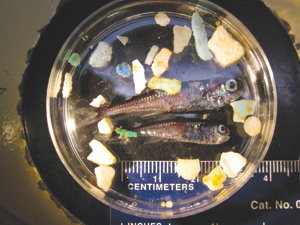
The first scientific results from an ambitious voyage led by a group of graduate students from Scripps Institution of Oceanography at UC San Diego offer a stark view of human pollution and its infiltration of an area of the ocean that has been labeled as the “Great Pacific Garbage Patch.” Two graduate students with the Scripps Environmental Accumulation of Plastic Expedition, or SEAPLEX, found evidence of plastic waste in more than nine percent of the stomachs of fish collected during a voyage to the North Pacific Subtropical Gyre. Based on their evidence, authors Peter Davison and Rebecca Asch estimate that fish in the intermediate ocean depths of the North Pacific ingest plastic at a rate of roughly 12,000 to 24,000 tons per year. Their results were published on June 27 in the journal Marine Ecology Progress Series. During the SEAPLEX voyage in August 2009, a team of Scripps graduate students traveled more than 1,000 miles west of California to the eastern sector of the North Pacific Subtropical Gyre aboard the Scripps research vessel New Horizon. Over 20 days, the students, New Horizon crew and expedition volunteers conducted comprehensive and rigorous scientific sampling at numerous locations. They collected fish specimens, water samples and marine debris at depths ranging from the sea surface to thousands of feet below. Of the 141 fishes spanning 27 species dissected in the study, Davison and Asch found that 9.2 percent of the stomach contents of mid-water fishes contained plastic debris, primarily broken-down bits smaller than a human fingernail. The researchers say the majority of the stomach plastic pieces were so small their origin could not be determined. “That is an underestimate of the true ingestion rate because a fish may regurgitate or pass a plastic item or even die from eating it. We didn’t measure those rates, so our nine percent figure is too low by an unknown amount,” Davison said. SEAPLEX was supported by the UC Ship Funds program, Project Kaisei/Ocean Voyages Institute and the National Science Foundation. — Courtesy of SIO


