


Marla Bingham’s 91-year-old mom makes a good case for advances in mainstream medical science. Her knee replacements have redrawn her world – gone is the limited range of motion that compromised her comfort and, more important, her independence. She’s even driving again, living to the max as new technology declares itself a full partner in traditional medicine’s evolution.
That seems at odds with Bingham’s expertise in the Pilates and Gyrotonic Expansion fitness systems, regarded by some as alternative quasi-medical practices in an age of alternative marketing. The fact is, Pilates has been around for about a century, and its close cousin, the Gyrotonic Expansion System, is more than 70 years old. By comparison, knee arthroplasty found its first favor as recently as the 1970s. It’s all about perception, Bingham said – in matters of optimum health, one person’s old school is another’s New Age, and vice versa. So goes the conversation on a recent afternoon at La Jolla’s The Marla Bingham Studio, where my firsthand exposure to Gyrotonic fuels an appreciation for brain-body communication, Bingham’s disarming commercial candor and the beauty of body movement as the studio marks its tenth year in business. The Gyrotonic Expansion System, created in 1942, looks to key principles found in dance, yoga, tai chi and swimming and stresses synchronized movement and breath. The explanation seems pretty simplistic, but its practical application may have saved its creator’s health. Hungarian swimmer and dancer Juliu Horvath, who suffered from chronic pain and the aftermath of an injury that ended his career with the Houston Ballet, crafted a novel series of exercises and routines that derived from his observations of nature.
“The octopus, the monkey and the cat,” Horvath said, “are my basic models, because they can move in any direction at any given time with strength and control because they have no restrictions. The human body has restrictions, but I can model the body ? within the framework of its restrictions ? to move in a similar way, to be free.”
Enter Massachusetts native Bingham, her background as a George Ballanchine dancer and the enormous physical toll it exacted. The Pilates and Gyrotonic systems, she reasoned, were logical progressions to fitness, and her licensed expertise is evident amid Horvath’s allusion to the animal kingdom.
“I’m always moving,” Bingham explained. “Most of us either don’t move enough or our movements are repetitive, activities that the brain is used to. But muscles are what’s called [parasympathetic], meaning that one [fires] off the other and so on.” Accordingly, Bingham’s casual and random movements are virtually effortless, taking their cues from synchronized breathing’s role in overall health.
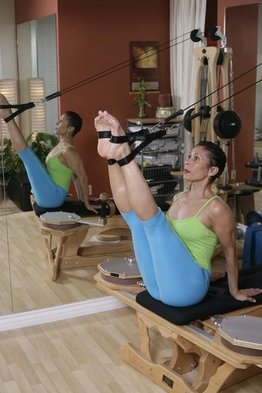
The client’s part involves an introduction to a body-fitting bench, a weight-driven set of pulleys and straps and Bingham’s attention to my breathing amid the slow, gentle stretches below the waist (a sore point for me). This isn’t so much exercises as attunement, an effort to align mental, emotional and pulmonary function. It works – after 45 minutes, I’m dizzy from the intake of oxygen and, more important, buoyed by the potential of an altered physical state. Bingham expected nothing less – meanwhile, she said, one benefit of her practice lies in its limitations.
“Gyrotonic,” Bingham said, “is not for everybody. Pilates is not for everybody. Yoga is not for everybody. Veganism is not for everybody. If you have an abnormality like scoliosis (curvature of the spine), nothing I do can fix it. I’m not a cure. What I can do is get you thinking about the brain and how it communicates with [your infrastructure] so that you can feel better.”
Bingham draws out the last two words as if declaring a prognosis. Feeling better, after all, sets the foundation for the brain-body connection that paves the road to feeling your best. To that extent, Gyrotonic is a success.
For more on Pilates and the Gyrotonic fitness system, call The Marla Bingham Studio at (858) 454-1224 or see binghampilates.com.


