


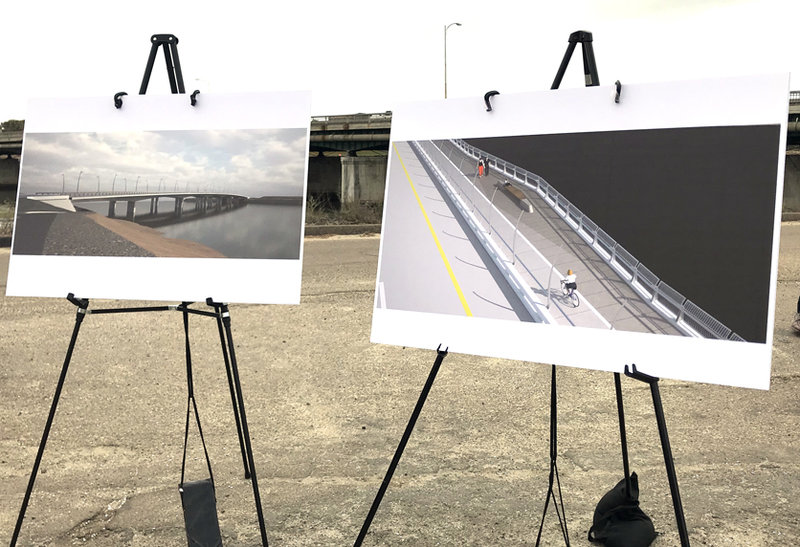
San Diego Mayor Kevin Faulconer, along with District 2 Councilmember Lorie Zapf and Public Works director James Nagelvoort, announced on May 30 that construction to replace the West Mission Bay Drive bridge will kick off this July. “It has served us well, but like much of the infrastructure in San Diego the time for it to be improved and modernized is long past due,” Faulconer said at a press conference near the foot of the old bridge.
This $110 million project will replace the current four lane bridge, built in the 1950s, with two separate three-lane structures. The bridge was recently classified as “fracture critical” by the California Department of Transportation.
“This bridge is supported by timber piles, something you don’t want to be driving over in the event of a major earthquake,” Faulconer said.
The new structures are to be built on either side of the existing bridge, meaning traffic will go uninterrupted for the duration of construction. A temporary bridge will be used on the northbound side to store construction equipment. Once the northbound side is completed, residents and tourists can expect the same procedure for the southbound side.
Once completed, these two parallel bridges will provide not only three driving lanes on each side, but also a protected Class-1 bike path on both sides and improvements to Sports Arena Boulevard, West Mission Bay Drive and the westbound I-8 off-ramp. All of this comes as apart of Faulconer’s “Proposed Fiscal Year 2019” budget of $633 million in one year, making it the largest infrastructure investment in San Diego’s history. The people driving, or biking, won’t be the only ones to benefit from the new bridge, but the environment will as well. Zapf noted that the area below the bridge is a 12-acre, sensitive habitat that needs improvement.
“What will happen is that invasive plants will be removed, and it will be revegetated with native species, which will lead to a better ecosystem and better water quality,” Zapf said.
Nagelvoort estimated that this project, being as large as it is, will be completed by 2022, making it an approximately three-and-a-half-year project.
“When this is done, this bridge is going to be seismically a lot stronger, have a much longer life span, and be able to hold up the earthquake activity much better than the current bridge,” Nagelvoort said.
Updated information on the bridge construction, including an animation of how the construction will be done, can be found when you search West Mission Bay Bridge at sandiego.gov.


