


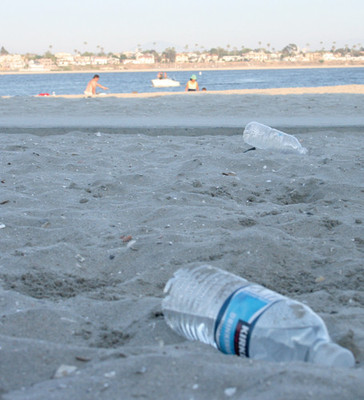
Plastic is a hydrophobic substance, often described by scientists as “water-fearing” for its ability to repel water and resist degradation when it is thrown away. So what is plastic debris such as bottle caps and cigarette filters doing in our oceans? This is one question Capt. Charles Moore asked at last month’s Surfrider Foundation chapter meeting.
To kick off Surfrider’s Rise Above Plastics campaign, Moore spoke about the negative impact of plastic waste on the Pacific Ocean and its surfers.
A graduate of the University of California, San Diego and an avid sailor, Moore founded the Long Beach-based nonprofit the Algalita Marine Research Foundation to study the marine environment. He has authored two papers on the growing presence of plastic waste in the Pacific Ocean, which Moore attributes to thoughtless consumerism and poor recycling programs.
In his presentation to Surfrider, Moore lamented the replacement of the wartime ethos of “conserve everything you can” with a 1950s consumer culture that celebrated disposable goods made of plastic.
“In just a few generations, we’ve totally changed our lifestyles,” Moore explained. “During World War II, metal had to be sanctioned “¦ throwing away beer cans would have been illegal.”
But today, “You’ve got materials that last virtually forever being used as a throw-away product,” Moore said. “So what happens to it? It goes into the ocean.”
According to Moore, America rose to its status as an economic superpower partly by ignoring waste build-up and failing to create a means of pollution prevention. Therefore, Moore said, “there is no recycling infrastructure to take back plastics, and the amount of plastic waste in the ocean has grown exponentially.”
Moore estimates that close to 3 percent of the world’s output of plastic products ends up in the ocean. Moore cited a study he conducted in 1999 that found six times the amount of fragmented plastic in the Pacific Ocean by weight than the amount of zooplankton, a naturally abundant marine inhabitant.
Moore also pointed out that the plastics used to make bags, clear bottles and food packaging contain controversial substances such as Bisphenol A, a chemical that mimics the sex hormone estrogen, and whose health effects are disputed by scientists and the plastics industry. Some animal studies have shown Bisphenol A to cause certain types of cancer, affect brain functions and cause miscarriages and infertility, but FDA regulators have found it to be harmless at the levels found in plastic packaging. Nonetheless, Moore charged that Bisphenol A and similar chemicals leach from plastic debris into the ocean and put surfers’ health at risk.
The San Diego chapter of the Surfrider Foundation sees solutions to the plastics dilemma in proposed California state legislation.
Surfrider is encouraging its members and San Diego residents to “Rise Above Plastics” by supporting bills proposed by State Assemblyman Paul Krekorian and State Sen. Joe Simian that would reduce the volume of plastic debris released off the California coastline. Surfrider just launched a letter-writing campaign from its Web site, www.surfridersd.org.
The “Rise Above Plastics” campaign, according to Bill Hickman, Surfrider’s San Diego chapter coordinator, should “help raise awareness about the plastic litter plague that’s out there. Between filling up landfills and some of the stray stuff that gets littered on our streets and sidewalks and makes its way out to the beaches, [plastic] has [a] really ill effect on the environment.”
This environmentally conscious program joins others regularly sponsored by Surfrider, including Aug. 18’s Hold On To Your Butt Day, when Surfrider members marched to raise awareness of the impact of tossed cigarette butts on the street and in the sand.
Surfrider has also called for the city of San Diego to emulate San Francisco’s recently passed legislation that prohibits supermarkets from distributing plastic checkout bags.
According to Jennifer Ott, public information officer for the San Diego Recycling Department, the city is not considering legislation to ban plastic bag use.
However, “We are going to be adding plastic bags to our curbside program in January to provide a more convenient outlet for plastic bags. Now [consumers] won’t need to take bags back to the grocery stores ” they can recycle them right at home.”
Pressure from community members and nonprofits such as Surfrider has prompted the city to re-examine its recycling program in other ways. Ott said that the city is drafting a recycling proposal that would encourage and might even require local businesses to recycle based on input from recent community stakeholders’ meetings.
In 2006 the city collected nearly 71,000 tons of recyclables and generated $4 million to offset the costs of its recycling program, according to official estimates. However, some officials speculate that around 80 percent of the items such as cardboard and bottles that San Diego residents put into their trash bins can be recycled.
“As far as responsibility goes, you know the city has limited resources,” Ott said. “The commercial and residential [communities] need to do their part as well, and that includes an education program and more recycling in general.”


