


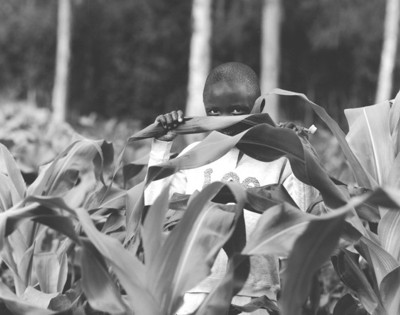
The Ordover Project Gallery in Solana Beach presents, once again, the work of physician and Point Loma photographer Art Myers. His current exhibit, entitled “The Forgotten Children,” is a touching series that captures the faces and spirit of African youth infected with the HIV/AIDS virus.
“The Forgotten Children” features a series of photos taken of residents at the Nyumbani Orphanage in Nairobi, Kenya. All the children photographed have HIV/AIDS and have been orphaned for a variety of reasons: infected mothers passed the antibodies from their blood to their children’s, some mothers did not survive child birth and others abandoned their children with no explanation.
Whatever the reason, the orphans photographed have been left to the care of the Nyumbani orphanage, Myers said.
“Sometimes, at birth, babies will test positive for the HIV antibodies,” he said. “But within one year, there is the possibility that a baby may convert to negative.”
If a baby is so fortunate, the orphanage will then seek out an adoptive family. Meanwhile, the young residents who remain at the Nyumbani Orphanage, while ill, are well cared for.
“I’ve never done well at shooting misery,” Myers said. “The importance of my photography is to recognize that people do suffer, but the majority of people that encounter adverse conditions do find strength and survive.”
Myers said he chooses not to portray suffering in his photography but rather prefers to celebrate survival, even if survival is inevitably temporary.
“When I first began looking into this subject,” Myers said, “I assumed I would show up and see these raggedy, poor, half-dead kids.” But when he arrived at the orphanage, Myers was elated to find a vision quite different than what he had expected. He saw immediate evidence that the children were given love, education and outstanding care.
“I knew that the [photographic] images couldn’t embody the ravishing affects of AIDS on these kids,” Myers said. “They were survivors.”
Before photographing “The Forgotten Children,” Myers was commissioned by a pharmaceutical company, now known as Pfizer, to document women living with HIV/AIDS. Some of the photos from that series were displayed in the October exhibit “We Are Women, See Us Rising” at the Ordover Gallery.
Unlike that project, Myers funded his trip to see the children in Africa straight out of his own pocket.
His original plan was to work with an orphanage in Haiti that sheltered children with AIDS, but early on, Myers sensed reluctance from the orphanage’s administration, “probably due to previous exploitation,” he said.
According to Myers, photographers who document areas that have been visited by tragedy often make an exhibition of how sad the subjects are. So to avoid further damage to a reputation for progress, the Haitian orphanage said Myers would be welcome if he could provide antiviral medication for 10 kids for a total of 3 years.
“They probably saw [me] this foreign doctor and saw an opportunity to get aid and supplies,” Myers said. “I would have done the same thing.”
Countless phone calls to Doctors Without Borders and other AIDS foundation supporters to obtain funding for the requested medication proved unsuccessful, and Haiti was no longer an option.
He first encountered the Nyumbani orphanage on CNN, which reported on it’s founder, Father D’Agostino, a former flight surgeon for the Navy, a psychiatrist and Jesuit Priest. Myers immediately contacted D’Agostino and was off to Africa.
Myers, his wife, Stephanie, and his assistant, Ellen Dieter, all stayed on-site at the orphanage. They slept in small quarters with cement beds and cold showers.
Myers said staying at the orphanage gave him the opportunity to become more than just a visitor. He became a piece of their lives and a familiar face that held no judgment.
As his photographs reveal, he had access to the children’s every-day lives, rather than single-segment photo ops.
“My photos are not portraits of kids with AIDS, but portraits of kids with care,” Myers said.
One particularly touching memory, Myers recalled, involves a young orphan girl who finds a photo he’d taken of a child that had recently succumbed to the disease.
“She picked up the picture and looked at it,” Myers said, “and with this complete look of “¦ celebration, she said, ‘So that’s where they go when they go.'”
After completing his photographic project in Africa, Myers returned to San Diego with a continued passion to broaden awareness of the AIDS epidemic. He collaborated with San Diego dance instructor and choreographer Gene Isaac to produce a memorable artistic endeavor entitled “The Song of Nyumbani.” The 2001 fund-raiser entertained hundreds of people with enlarged black and white photos, improvised dance and a live choir, raising $15,000 in honor of the orphanage and children living with HIV/AIDS worldwide.
Myers said he is dedicating the current exhibit to the memory of his 10-year-old grandson Paulie, who, like many of the children in these images, lived a life too short.
In addition to Myers’ work, “Solitude” by Peter Fay is also on display. Fay’s portfolio ranges from the textured, enchanting designs of the Southwest canyons to the quiet stillness of snow-capped scenery.
“The Forgotten Children” and “Solitude” are on display through May 6 at the Ordover Gallery, 444 South Cedros Ave., studio 172, in Solana Beach. The public is invited to attend the opening reception Thursday, April 19, from 6 p.m. to 8:30 p.m. For more information, call (858) 720-1121 or visit www.ordoverproject.com.


