


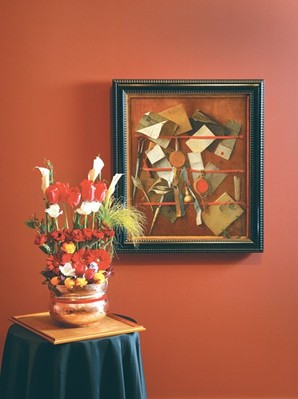
Most of the time, the San Diego Museum of Art can look forward to 8,000 to 12,000 visitors for Art Alive, its annual installment of floral displays inspired by the museum’s works of art. That’s a pretty healthy count for something that lasts only three days ” but this year, another exhibit may steal some of the thunder, prompting one museum official to lightly invoke “crowd control” as the mantra of choice.
The 26th Art Alive, set for April l3 to 15, is running concurrently with the final few weeks of the very popular “Annie Leibowitz: A Photographer’s Life, 1990-2005,” which closes on April 22 and then leaves Southern California for good.And Chris Zook, the museum’s senior communications officer, notes that “there’s going to be (the annual) EarthFair in Balboa Park on the same day, so it’s going to be really hard for people to wait for the very last minute to come and see the Leibowitz closing.”
Zook said the museum is formulating a plan to issue time tickets, or admissions by appointment, to regulate crowd flow during Art Alive.
Meanwhile, 12,000 visitors ” a whopping 3 percent share of the museum’s annual foot traffic ” can’t be wrong. Zook said that the show, which includes displays by dozens of artists, is worth braving the crowds. He noted that floral arrangements are as legitimate a medium as the paints and canvases that advance any artistic endeavor.
“If you look at art, flowers have been a major motif that artists have depicted for centuries ” some of the Dutch still-lifes or some of the work the Impressionists did,” Zook said. “Flowers are also prominent in Japanese art. As far as the artistic skill involved, a lot of these designers are trained in some sort of floral design school. Either they’re professional floral designers or they’ve been trained in ikebana, a major flower design [school]. They’re sculptors. Their medium is flowers, but they create a sculpture.”
Enter Organic Elements, this year’s designer of the museum’s rotunda fountain. The North Clairemont firm is keeping things close to home ” and in the process, it’s casting an eye toward environmental health.
“We’re using a lot of succulents and orchids this year,” Sharon Mintz, owner of Organic Elements, said. “It’s nice to use something that’s local and that’s been almost overlooked. We have them everywhere [in this region], and we sort of pass them by.
“But if you look carefully, you’ll find them in all sort of colors and styles. Some look like rocks and hide their fruit from their prey. Some have prickly edges. It’s just neat, and it offsets a little bit of the [transport] fuel consumption of the flowers we’re importing from New Zealand.”
Succulents are markedly long-lived and contain great quantities of water in their leaves, stems and roots. The family includes about 1,000 species, among which are begonias, aloe and most cacti.
The intended effect, Mintz said, is “upper East Side New York chic. We’re trying to create an indoor garden. A lot of people don’t have backyards. They live in apartment buildings, so we’re trying to bring the outside in.”
That’s where the fountain enters the picture. Each of its three tiers will be filled with some sort of iron-based urban component, replete with flowers and plants. San Diego’s CQ Welding is supplying the fixtures.
Meanwhile, Zook said, Art Alive represents “a value-added kind of thing. You get to see the art, of course, but you get to see the incredible floral displays. When you combine a floral arrangement with a masterpiece of art, it’s a perfect marriage.”
Art Alive will also include an April 13 lecture and demonstration by designer Nico de Swert and an April 14 Floral Fete, featuring live entertainment and hors d’oeuvres.
The museum is located at 1450 El Prado in Balboa Park; the phone number is (619) 232-7931. Art Alive exhibition hours are 10 a.m. to 6 p.m. Tuesday through Sunday.
Admission is $12 for all adults, military and students with ID. Youths 6 to 17 will pay $5; museum members and children under age 5 are admitted free.


