


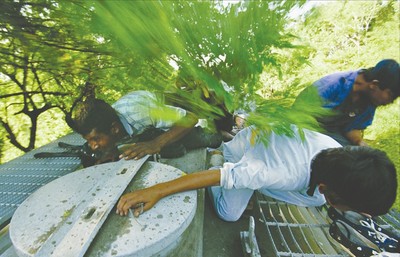
The Museum of Photographic Art (MoPA) has mounted two complementary exhibits that at once seem worlds apart and inexorably linked: The first focuses on illegal migrant travel in Latin America and the other centers on the revolution that may have inadvertently helped fuel such flight out of Mexico.
On Sunday, Nov. 12, MoPA unveiled “Mexico: The Revolution and Beyond – Photographs by Agustin Victor Casasola, 1900-1940,” featuring more than 90 images depicting daily life during and after the Mexican Revolution. Casasola sought to capture Mexico as it underwent the transition from an agrarian to a modern society during the first half of the 20th century. He’d compiled nearly 500,000 photographs on the revolution during his four decades in photojournalism; their thrust ranges from street life and combat scenes to portraits of grass-roots vigilantes and famous figures such as Pancho Villa and Emiliano Zapata.
Photos of booming city streets and Mexico City nightlife also caught Casasola’s eye. On the strength of these pictures, he and his brother Miguel eventually formed an agency whose archive totaled 1 million photographs.
The revolution began in 1910, with its proponents seeking the overthrow of dictator Porfirio Diaz Mori. The fighting culminated in the adoption of the present Mexican Constitution in 1917, but civil unrest persisted through the 1920s. In 1921, drawing on the thousands of photographs in his archive, Casasola published the classic “Album Historico Grafico de la Revolucion” (“Illustrated Historical Album of the Revolution”), which traces the history of the uprising from 1910 to 1920 in texts and photos.
“Mexico: The Revolution and Beyond” runs through Jan. 7.
Whereas the aforementioned show depicts Mexico at its most tumultuous on the world stage, the current entry notes the nation’s less public upheavals during the end of the last century. It’s called “The Roads Most Traveled: Photographs of Migration by Don Bartletti,” and it includes more than 90 images of the lives of migrant workers during the past two decades. Included are images from “Enrique’s Journey,” for which the Los Angeles Times photojournalist received the 2003 Pulitzer Prize for feature photography. The photos follow the journey of migrants form Central America, some as young as 12, who annually attempt the illegal 1,500-mile journey through Mexico on top of freight trains.
“Bartletti’s images … are especially relevant to us as San Diego residents,” said MoPA curator Carol McCusker. “The migration of workers has become the crisis of the 21st century. With this exhibition, we would like to help bring the often-invisible migrant population into view, give them a voice and encourage a local climate of understanding through the powers of photography.”
This entry will close Jan. 14.
The museum is located at 1649 El Prado in Balboa Park. It is open Mondays through Sundays, 10 a.m. to 5 p.m., except for Thursdays, when it closes at 9 p.m. Admission is $6 for adults, $4 for seniors, students and the military and free for members and children under 12. Admission is also free the second Tuesday of the month. More information is available at (619) 238-8777 or at www.mopa.org.


