


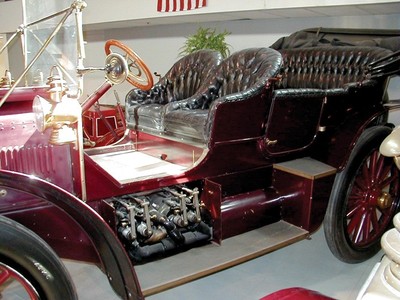
Designers and constructers popped up in nondescript garages at the turn of the 20th century, spending countless hours and money trying to produce a different automobile.
They dreamt of becoming another Henry Ford, cramming two-cycle engines into carriages. Much later, a new breed sought to rival Detroit’s stylists with promising chassis and fiberglass bodies with “progressive” features. It was a countrywide phenomena.
San Diego County was no exception with its breed of innovators. Still, these small car companies furnished little more than a handful of prototypes.
Before World War II, the short list included an Andrews (1899), Hensley (1901), Great Western (’07-’08), Hunt Special (1910) and Griffin (1930). Afterward came the Bobbi Car (’45-’47), Airway (’49-’50), Town Shopper (1949), Del Mar (1949), Yank (1950), Charles (’58-’59), Crofton (’59-’61) and Swift (’59-’60),
Some interesting ideas might have caught the fancy of the country’s big manufacturers, but for the most part, Detroit and Dearborn weren’t worried about the experimentalist upstarts. These dreamers tinkered with two- and four-cycle engines, utilized fiberglass and aluminum bodies and a number of other innovations that never saw a showroom.
The curious Hunt brothers, Clarence and William, probably came closest to being what auto industrialists looked for. Had others established a liaison with investment money, a facility and materials, their venture might have been far-reaching.
The Hunts considered repair work more rewarding. Yet, when it came to producing a vehicle or engine, they were masters. For $16,000, they built a sturdy Hunt Special in 1910 for an Ensenada rancher to tackle the rough Baja wilds. Later, they built a van for a bakery.
They had been hired by the Great Western car company in 1907 to build two-stroke engines. Principals in the company were the Brimhall brothers, with $200,000 in stock options. They ran out of cash and skipped town.
The first known San Diego attempt was the 1899 Andrews with an air-cooled motor attached to a carriage. Inauspiciously, the expansion of air in the motive unit produced such intense cold that ice formed and the pipes froze.
A Motor Age magazine writer harpooned the project, stating it would be too complex to fix and probably unsatisfactory. Andrews abandoned his project.
Along came George A. Hensley’s 1901 car bearing his name with an improved air-cooled engine. The Hensley, tipping the scales at 283 pounds, would go 10 to 12 mph on a good road. It was a spare time project and Hensley didn’t bother to manufacture it.
It wasn’t until 1930 that a three-wheel Griffin was introduced. It was built on “rubber band” principles with a four-cylinder engine that had been on a motorbike. Overall it looked like a postwar Messerschmidt.
A new set of dreamers came along from 1945 through 1960.
First up was S.A. Williams’ Bobbi Kar with an economical notch-back coupe, fastback sedan and station wagon body types made of fiberglas. The coupe had a removable steel top.
Then there was the Airway in 1949, a. small light car designed by T.P. Hall and Everett Miller. Hall made several attempts to build a flying car, but the Airway was confined to the ground.
An electric car in 1958 called the Charles was a dream of Dr. Charles H. Graves, vice president of Stinson Aircraft. The fiberglas body resembled the Volkswagen Karmann Ghia with 1957 DeSoto taillights. It was mounted over an aluminum frame with two electric motors.
A 1948 Town Shopper, billed as America’s lowest priced ($505) automobile, was designed for short shopping trips with a luggage compartment in front. A two-cycle, two-speed engine was rear mounted and got up to 50 miles per gallon.
The 1950 Yank was a poor man’s sports car attempt. It was a low-cost, Willys-powered, aluminum-bodied car of fairly good looks. But it failed to succeed like so many others.
” Watch for Johnny McDonald’s “Auto Biography” car column each month in the Village News.


