


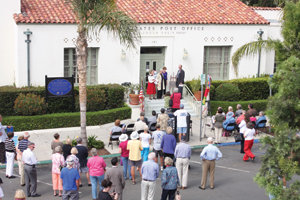
With nearly two-thirds of the goal met in donations and pledges, and with only about $720,000 left to be raised, the La Jolla Historical Society has announced the public phase of its capital campaign. The “quiet” phase of the Society’s $2 million campaign, launched in January 2007, was based on the projected costs of renovation and adaptation of the three structures on the property, located on the corner of Eads and Prospect Streets in La Jolla. The site includes the landmark 1904 Wisteria Cottage, Ellen Browning Scripps’ 1896 carriage house, the 1909 beach cottage that serves as the society’s administrative offices, and the historic grounds upon which all three structures reside. “When we started the campaign,” Capital Campaign co-chair Ann Zahner said, “we were just leasing the [Wisteria Cottage] property. Then, in July 2008, the late Ellen Revelle and her family, based on what they saw being achieved at the La Jolla Historical Society, deeded the property to the society. I think we showed that we have a vision about which they were enthusiastic.” Melesse Traylor, the campaign’s co-chair, emphasized the significance of the Revelle donation. “This property had been in the Scripps-Revelle family for over a century,” she said. “Ellen and her children wanted to ensure Wisteria Cottage would be preserved and made available for the wider community’s benefit. The La Jolla Historical Society has been entrusted with an important responsibility and we take that seriously. However, the society can only do so with the community’s support.” Funds raised early in the campaign were used to make interim improvements to Wisteria Cottage and the adjoining Balmer Annex to allow the Society to begin immediate use. It also allowed the Society to begin addressing the many years of deferred maintenance and basic cosmetic and functional repairs essential to its emerging programs. Floors were refinished, interior walls painted and the beautiful windows in Wisteria were finally made operational. The Balmer Annex, the first home of what is now known as La Jolla Country Day School, was given very rudimentary upgrades to paint, carpeting and lighting. Bathrooms in Wisteria were made functional though extensive remodeling is still planned to make them ADA-accessible. On the outside, the iconic but deteriorating redwood pergola on which the namesake wisteria vines have grown since the early 20th century was rebuilt to exact specification to the original by La Jolla small businesses Bennett & Associates, Grunow Construction and Dewhurst & Associates. During the pergola’s rehabilitation, the wisteria itself was meticulously trained and pruned under the oversight of master gardener and board member Betty Vale to ensure its stability. Finally, the previously-crumbling front entry concrete walkway was replaced with a new wheelchair-accessible walkway — the Society’s first major effort to ensure greater community accessibility to the historic structures. Earlier this year, renovation of the carriage house to become the Society’s new archives collection storage facility was completed. While the interior was transformed to permit installation of movable shelving (funded by a generous grant from Las Patronas), specialized climate control and fire suppression systems, and a new security system, the exterior façade was restored thanks to the volunteer efforts of John Peek of Peek Brothers Painting and Mike Chism of Chism Brothers. The two La Jollans and friendly business rivals partnered to make the carriage house’s exterior serve as a stunning example of how historic preservation works. With only about $720,000 left to be raised, the Society plans to continue the renovation, effectively divided into four phases. “With the carriage house, the first major phase has been completed thanks to generous early supporters,” Executive Director John Bolthouse stated. “Work in subsequent phases will focus on landscaping, including grading, fences and repairs to sidewalks, along with restoration of Wisteria Cottage’s façade. The third phase will complete the interior renovations of Wisteria Cottage to become a truly multi-use facility for exhibitions, education programs and events. Finally, rehabilitation of the 1909 cottage is planned to feature a more modern and accommodating venue for researchers and more habitable space for staff and volunteers.” In recent years, the Society has presented a flurry of free public exhibitions, programs and events in Wisteria Cottage as part of its efforts to generate greater interest in its emerging role in the community and vision for its future. “Ever since this campaign began,” Bolthouse emphasized, “one of our highest priorities has been to show our generous community supporters — both current and potential — that the La Jolla Historical Society is a good investment of their philanthropic support. History matters in La Jolla, and this organization is the community’s best resource for championing that history.” Traylor and Zahner hope that an improved economy will provide a boost to the campaign but they’re not waiting — strategies aimed at appealing for greater support are underway. “We need a few large gifts to help match the $500,000 anonymous challenge we received in late 2008,” Traylor said. “We believe La Jollans will step forward because they love La Jolla.” La Jolla’s connection to its rich heritage, the La Jolla Historical Society’s offices and archives are located at 7846 Eads Avenue, La Jolla. Open to the public Monday through Friday, 10 a.m. to 4 p.m. Exhibition Gallery open Thursdays and Fridays, noon to 4 p.m. Phone (858) 459-5335. www.lajollahistory.org.


