


This is totally ridiculous! No one is talking about the RESIDENTS!! What are the people who already live in North Park supposed to do with their cars? They have jobs that are not realistic to bike to. This is not the suburbs where every house is a single-family house with a two-car garage. Almost every house on our street is multi-unit. Many of the houses don’t have garages or driveways and if they do, the majority only fit one car. I don’t understand taking away all that parking for the few people that want a bike lane.
Jannette Mueller, via Facebook
There is a large parking facility in central North Park, theoretically making parking easier. Yes, it’s paid parking, but so are most places now because parking is obviously a valuable commodity. To me, this makes North Park’s transit issues a bit different from other parts of town like Hillcrest.
Mary McKenzie, via the website

I am incredibly ecstatic about the approval for bike lanes on 30th Street in the North Park neighborhood and would like to encourage Chris Ward and Kevin Faulconer to continue their support.
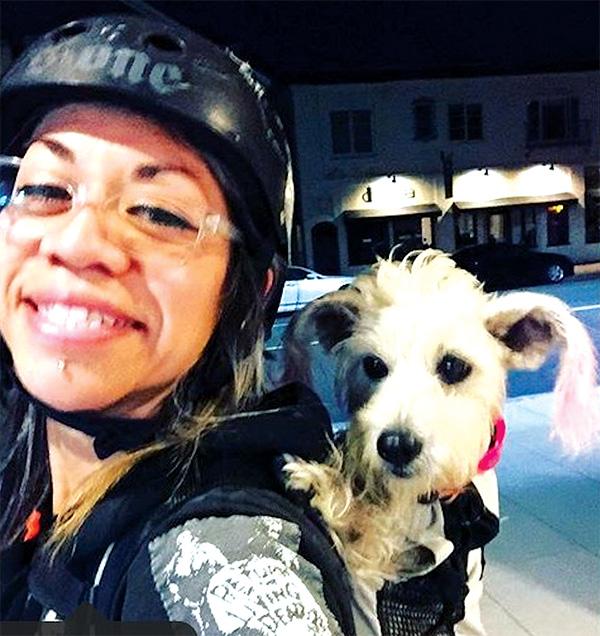
I moved to San Diego seven years ago from Seattle — a city where public transportation and cycling are widely used by its residents for practical and environmental reasons. My sole form of transportation is by bike; I also bike regularly with my dog, so safety is of great concern to me.
San Diego has such a sprawling (and promising) infrastructure that the addition of bike lanes to our city will be a healthy and positive change for future generations. As an employee of the North Park neighborhood, I witness on a daily basis the advantages of last-mile transportation (biking/shared biking/scooters) and look forward to the changes the bike lanes will bring to this bustling, trendy neighborhood.
Lisa Y. Méndez and Olive the terrier mix, who live in Golden Hill and are employed in North Park
I just read your article about the parking/bike lanes on 30th Street and I take exception to your comment that North Park was ever a “slum.”
I have lived in this beautiful neighborhood near Morley Field since 1976, at which time 30th and University was a vibrant area with dress shops, banks, restaurants and other businesses, such as J.C. Penney (later REI). With the rise of Mission Valley, some of these businesses moved to malls, leaving some buildings empty. However, the historic Craftsman homes made this an area that people loved and wanted to move into. North Park was never a slum and you should apologize to the community for this blatant mischaracterization!
Rachel Burnage, North Park
I take strong exception to your article where you say that North Park was once considered “a slum.”
I have lived in North Park, Morley Field for almost 70 years. My family moved into NP in 1945. Back in the late ’70s to early ’80s, it got a bit run down due to aging homeowners, but it was never a slum! New families moved in then and re-gentrified the area. A resurgence of that is now occurring.
Perhaps in the future, before writing such an inflammatory comment, you should ask for many opinions, especially from those of us who’ve lived here apparently longer than you have. I’m assuming, of course, that you live in North Park. If not, all the more reason!
Sherrill Joseph, Morley Field
In response to a prior article concerning North Park, wherein it was stated that the area had previously been “a slum,” I am hereby setting the record straight because that’s not what it was.
I grew up in North Park and have lived in the same house here for 80 years. This is how North Park was in the 1940s, 1950s, and to a certain extent, beyond those years:
– Two movie theaters: the North Park Theatre and the Ramona Theatre.
– The Palisades Roller Rink.
– A J.C. Penneys store and a Woolworths.
– Lawsons Jewelers.
– Two banks.
– An Owl drugstore.
– Clothing stores.
– Corner grocery stores, as well as one large grocery store (the name now escapes me).
– A bowling alley.
– Other businesses, including dental/medical facilities, insurance companies, shoe repair businesses, etc.
– Restaurants, including one owned by my father on University Avenue (now called Lucha Libre). Also, the longtime Peking Restaurant which, unfortunately, just closed.
– Local schools to which most of the children walked.
– The same tennis courts, baseball diamonds, and swimming pool at Morley Field which still exist.
There may be many other things that I may have omitted. However, I simply wish to point out that there were many business and recreational facilities which created a very family-friendly neighborhood. We didn’t have to travel to Mission Valley or elsewhere to do our shopping, to conduct business, or for entertainment.
Finally, most of the homes in the 1940s and 1950s were single-family homes, before the influx of apartment and condominium complexes. Also, there wasn’t the proliferation of bars and breweries which we’ve seen over the last few years.
Nikki Nicholas, North Park
[In response to these readers writing in, sduptownnews.com has been updated to say North Park experienced a downturn in the 1980s, and take out the word ‘slum’ which was offensive and inaccurate]


