


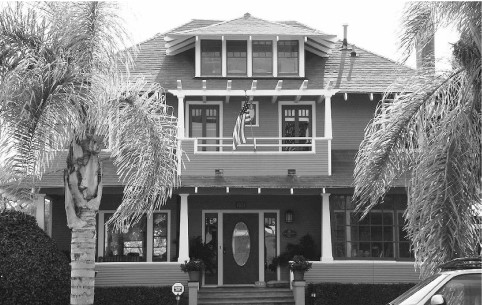
Misson Hills protects its historic treasures
Por Priscilla Lister
 Mission Hills boasts some of the most beautiful historic neighborhoods in the city. It is an excellent place to find inspiration from its historic architectural styles.
The Mission Hills Historic District, formally designated in 2007, was “the first resident-funded and driven district in the city of San Diego,” says a publication from Mission Hills Heritage, a group of local preservation-minded residents.
This district includes 75 homes along the 1800 block of Sunset Boulevard and all those along Lyndon Road and Sheridan Avenue.
Adjoining this district, the Fort Stockton Line Historic District consists of 107 homes along parts of Fort Stockton Drive, West Lewis Street and Pine Street, approved also in 2007.
A proposed extension of the Mission Hills Historic District includes 99 homes on the blocks between Sunset, Witherby Street and Fort Stockton.
The area of the original Mission Hills Historic District was first known as Johnston Heights when Captain Henry James Johnston bought 65 acres from the city of San Diego in 1869 for a total price of $16.25. A seafaring captain of the ship Orizaba, Johnston ferried passengers from San Francisco to San Diego. He wanted to build a home overlooking the harbor, but didn’t need that much land, so he sold 50 acres to a shipmate for $1 per acre – $50 total. Sadly, he died in 1878 before he could build his dream home.
His daughter, Sarah Johnston Miller, did build that home in 1887, which became the first house in Mission Hills. Though remodeled significantly from its original Victorian style into a Prairie style in the early 20th century, Villa Orizaba, as it is still known, stands today near the intersection of Orizaba and Miller streets in that proposed historic district extension area.
Sarah’s son, Henry Miller, subdivided his holdings in 1909, renaming Johnston Road to Sunset Boulevard and calling the neighborhood Inspiration Heights. A marker naming this area still stands today on Sunset Boulevard.
Another syndicate was formed to buy and develop 60 acres in this area in 1908, with that parcel then costing $36,000. City leader George Marston also bought a 22-acre parcel bounded by Fort Stockton and Arden Way and gave the area its formal name of Mission Hills when his subdivision map was filed in 1908.
Kate Sessions, often called the “mother of Balboa Park” for her horticultural work, was also an early land owner in Mission Hills, where she lived from about 1903 until 1927. She also played a major role in the area’s development, which skyrocketed in the early 20th century when the city’s streetcar extended to the intersection of Fort Stockton and Trias.
Mission Hills Nursery, still located on Fort Stockton, was started by Kate Sessions in 1910, so this year it celebrates its 100th anniversary and its claim as the oldest nursery in the city.
These early civic leaders wanted to make Mission Hills one of the most exclusive areas in San Diego, and it did, in fact, become the city’s first restricted subdivision. Only single-family homes costing at least $3,500 could be built and barns had to cost at least $500 each – during a time when the average worker made $10 a week.
Mission Hills quickly became known as an area of wealth and affluence. In the 1910s, Craftsman architectural styles predominated, with elements of Prairie and Pueblo styles continuing well into the 1930s. In the Mission Hills Historic District, you’ll also find homes designed in Spanish Revival, Spanish Electic, Mission Revival, Dutch Colonial, English Tudor and other styles.
Several master architects of the time worked there as well, including William Hebbard (a longtime partner with Irving Gill), Richard Requa, Nathan Rigdon and others.
You can easily walk the blocks of the Mission Hills Historic District by starting along that 1800 block of Sunset Boulevard and moving west along Sheridan Road and Lyndon Road.
See if you can determine each unique home’s historic architectural style: Craftsman, which comes from the title of a popular magazine published by furniture designed Gustav Stickley between 1901 and 1916, typically features wood, stone or stucco siding, a low-pitched roof, wide eaves with triangular brackets and exposed roof rafters with front porches; Prairie, largely credited to Frank Lloyd Wright, was popular from 1900-1920 and is characterized mainly by strong horizontal lines, clerestory windows, overhanging eaves, open floor plans and a low-pitched roof; Spanish Colonial with its stucco siding, decorative tiles and red-tiled roofs; Dutch Colonial with its gambrel-shaped roof; Greek Revival, which usually features a symmetrical shape and an entry porch with columns; and Tudor, usually featuring heavy chimneys and decorative half-timbering.
While we were walking in this charming neighborhood, we chatted with one longtime resident, Hugh McArthur, 98, who has lived in his home there since 1955. A native San Diegan, he graduated from San Diego High School and told us he used to be a “steel magnate.” His company, Southern Equipment & Supply Co., distributed “all the steel in San Diego for 50 years,” he said, “also helping to build Tijuana and Ensenada.”
“The neighborhood has held up beautifully,” he told us. “And we always get lots of sun.”
Inspiration Heights has obviously inspired many residents over the years to take care of their historic treasures.
Find lots of information about these historic districts and what they mean at both missionhillsheritage.org as well as sohosandiego.org. View a list of historic sites throughout the city at sandiego.gov/planning/programs/historical/pdf/landmarklist.pdf.


