


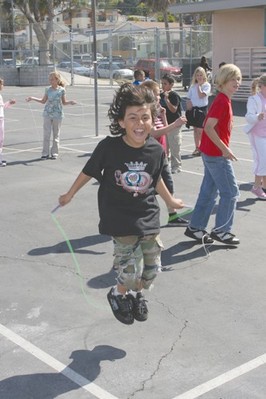
Physical education teachers at peninsula elementary schools know how important health and fitness is for young children, which is why they are going above and beyond the call of duty. Many of these teachers have organized fitness programs outside school hours to give their students the knowledge they feel the state and the district have failed to provide.
“I think we could really do better at educating the kids to keep a healthier body. We’re working on it, but I think it could be stressed more,” LaRue Rockhold, physical education teacher at Ocean Beach Elementary, said.
In order to improve that education, Rockhold as well as Edie Duncan of Loma Portal Elementary ask their students to voluntarily rise early to exercise not only their minds but their bodies at before-school running groups.
“It’s just a really good way to start the day. Getting your heart rate going, your cardiovascular system going “” it really wakes the kids up so they’re ready to learn,” Duncan said.
Loma Portal’s “Run for Life” meets every morning before school; the Ocean Beach program meets Monday, Wednesday and Friday. In both, students run with the incentive of receiving a token for the number of laps or miles. As students earn more tokens, they come closer to earning a medal at their year-end awards assembly. Each school’s parent-teacher association provides the minimal funding needed to purchase tokens and other medals awarded the students.
“I have one little boy who has already run almost 80 miles,” Rockhold said.
According to both schools, about half the student population participates. And at Loma Portal, parents and younger siblings often run with the students.
These teachers know that running and jogging isn’t the only way to get your heart rate up. Activities such as dancing, swimming and even jumping rope can all help your heart.
Many peninsula elementary schools participated in the American Heart Association’s fund-raiser Jump Rope for Heart. The event raised money for the association and helped to educate the kids about working out their heart muscle, Rockhold said.
An American Heart Association representative came to each of the participating schools with jump ropes and tools to teach the children about their heart.
“I had a lot of little talks with the kids, which is really kind of cute,” Rockhold said, adding that the kids shared stories of family members who had suffered from heart disease.
Loma Portal also helped start the Klassic Kids program, an extended school day program.
Candy Snell, Klassic Kids director, said she tries to focus on health and fitness for her students.
On March 23, the Klassic Kids group performed a health and fitness variety show for the entire school.
“We’ve got a lot of kids who are part of exercise routines and skits, and we’re trying to make it fun for the kids,” Snell said.
Snell also incorporates food tasting during Klassic Kids, including samples of fruits, vegetables and healthy breads and cereals.
“We introduced dragon fruit to them,” Snell said.
While teacher- and parent-organized events such as these are prevalent at peninsula schools, some teachers have expressed concerns that the state has let health and fitness fall through the cracks, especially with the ever-increasing problem of childhood obesity.
“I’ve heard talk of this,” Rockhold said of the California Department of Education’s push for increased education of health and fitness issues. “I haven’t seen it necessarily in the schools yet.”
“I think probably literacy is more of a big priority with the district,” Duncan said. “I can’t say that they’re making [health and fitness] a priority.”
Rockhold, 57, remembered her school years and the constant presence of physical education.
“I had to take physical education all the way through junior college,” she said, adding that while there is a push for more fitness education at the middle school level, she sees a decline at the high school level.
The California Department of Education requires elementary school students to have 200 minutes every 10 school days, while grades 7 to 12 require 400 minutes every 10 school days, according to the department’s Web site. But the increase in minutes is countered by the fact that high school students are only required to take two years of physical education.
Carol Barry, peninsula-area superintendent for the San Diego Unified School District, said she wasn’t sure why physical education declines as students reach higher grade levels.
“I wouldn’t be surprised if we see some more changes because of the obesity we’re seeing in children,” Barry said.
She noted, however, that an increase in physical education or health typically requires taking time from another subject.
“I think probably a better solution would be how do you weave a healthy lifestyle into lots of things you teach,” she said.
Barry suggested discussion of healthy choices in literature and study of the body and health in English language courses. She also suggested requiring students to do a research project on health-related topics such as fats in our diets.
Rockhold agrees that health and nutrition are important and should be integrated into all of education.
“When you educate, you educate the whole child, and to educate the whole child you have to educate not only mentally but their physical being as well,” she said.


