


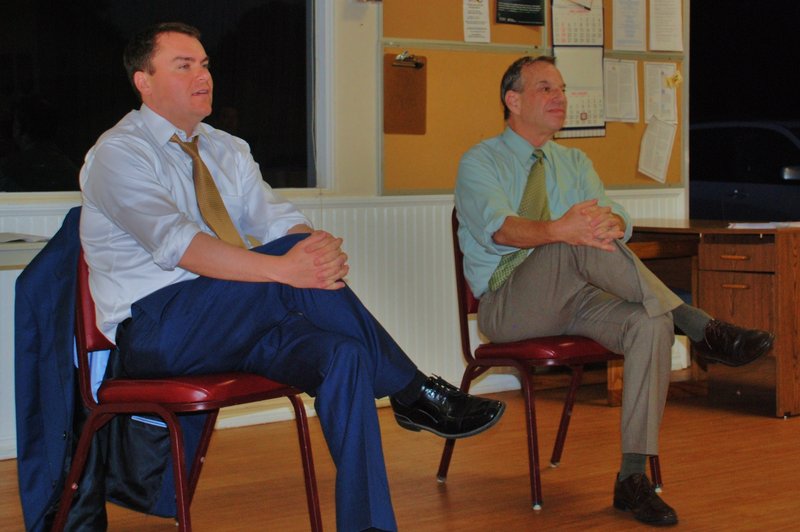
Hopefuls distinguish views; share common ground, too In a mayoral campaign noted for its divisiveness, Carl DeMaio and Bob Filner actually found significant areas of agreement during a candidate forum Aug. 22 hosted by the Ocean Beach Town Council (OBTC). Although the race is officially nonpartisan, it pits the Republican DeMaio, who represents District 5 on the San Diego City Council, against Democrat Filner, 10-term member of the U.S. House of Representatives. The two will vie for voter approval in the November election. Both men support the legitimacy of medical marijuana and want to end homelessness, especially among the city’s veteran population. DeMaio and Filner want to make crossing the border more efficient. Both condemned the decline of basic services and neither candidate wants to build a new city hall. The candidates also agreed not to weaken restrictions in Ocean Beach’s zoning code — a stand that pleased members of the Ocean Beach Planning Board, which has repeatedly fought variances that allow three-story homes to be built in the middle of one-story duplexes in the 5100 block of West Point Loma Boulevard. But perhaps their biggest similarity was that they both spoke of themselves as agents of change — at times, even in historic terms. It was this subject that allowed the candidates to best differentiate themselves during the 1 hour, 25 minute forum, in which the nearly five dozen in attendance were invited to submit questions to the OBTC, which then selected 18 questions to ask of the candidates. Time constraints allowed for only 10 questions, but the remaining eight will be submitted to the candidates and their answers will appear on the OBTC website, said vice president Brennen Bazar. DeMaio pointed to his support of Proposition B, the pension-reform measure he championed last June, and opposition to a 2010 ballot initiative that would have temporarily raised sales taxes, as proof of his ability to stand up to special interests. Proposition B, which replaces the public-employee pension system with a 401(k)-style program, has turned San Diego into a “model for how to deal with out of control and unsustainable pension benefits,” DeMaio said. He said the sales-tax measure had united a coalition of “downtown insiders, big business, labor, the mayor and a Democrat council. “I said, there’s someone you didn’t invite to that back room where you carved out this [tax measure] deal: the working family and small-business owner,” DeMaio said. But Filner said it was laughable to cast DeMaio as a champion of the common citizen. “Carl talks about ‘Those downtown special interests.’ Who the hell do you think funds him?” he said. Filner said neighborhoods have been hurt in recent years because recent City Councils have overemphasized downtown redevelopment. He applauded the decision last year to abolish redevelopment agencies throughout the state. “People can make money downtown without the $200 million subsidy. Let’s move that money to where it’s needed. What about the infrastructure and all our neighborhoods? I’m all about putting the power back into the community and away from where it’s been. That’s why the downtown folks have so many problems with me.” But DeMaio charged Filner was making promises and avoiding tough decisions. “That’s what every politician does. Every girl gets a pony and every boy gets a bike,” DeMaio said. He said his 249-page budget plan would improve services and restore infrastructure funding through performance audits of all city departments and through managed competition. He said any service offered in the yellow pages — he cited landscaping and auto maintenance as examples — could be put out for bid to compete with the private sector. The practice has already led to more than $1 million in savings, DeMaio said. “My plan shows dollar for dollar, line by line and reform by reform exactly how we’re going to get it done,” he said. Filner had a retort. “I keep hearing the word ‘reform.’ Do you know what that means? Real estate for Manchester,” Filner said, drawing a hearty laugh from the pro-Filner crowd in making a reference to Doug Manchester, publisher of the Union-Tribune San Diego newspaper that has endorsed DeMaio. “Mr. DeMaio blames everything on our public employees. Hello? We need them,” Filner said. “It was the greed on Wall Street that caused a 50-percent loss in our pension fund, not the greed of our public employees.” Filner said his support of labor would put him in a better position to implement the obligations of Proposition B. “You tell me who’s going to be able to walk into that room and be able to negotiate a pensionable pay freeze for five years when every public employee thinks Mr. DeMaio threw them under the bus,” he said. In response to a question about how to create jobs in San Diego, DeMaio listed three things: better regulatory environment, education and public investments in such things as a third border crossing, a regional airport and an expanded convention center. “We are not an attractive city for people to come and invest in San Diego,” DeMaio said. Filner said he wanted to add solar power to all public buildings in five years and expand the Port of San Diego. “Until recently, there’s been very little commerce. We’re the biggest city on the West Coast that has no major cargo,” Filner said. He again chided DeMaio’s connection to Manchester, who supports a football stadium at the Tenth Avenue Terminal. “These are public assets,” Filner said. “They should be in the public interest, not Mr. Manchester’s interest.” “We’ve had a mayor and City Council … dominated by downtown special interests, mainly through money. My election would be the biggest change in 50 years,” Filner said.


