


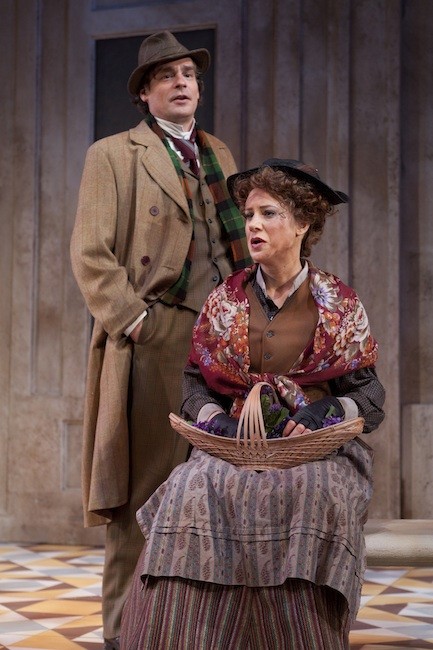
‘Pygmalion’
WHERE: Old Globe Theatre, 1363 Old Globe Way (Balboa Park)
WHEN: Tues. – Sun. through Feb. 17
INFO: 619-234-5623
WEB: theoldglobe.org
Superbly cast production based on Old Globe glory
By Charlene Baldridge | SDUN Theater Critic

The Old Globe takes a giant step back to former glory with its luscious and lavish production of George Bernard Shaw’s “Pygmalion,” the stage play upon which Lerner and Lowe’s 1956 Broadway musical, “My Fair Lady,” is based.
Not only is “Pygmalion” a feast for the eyes, the production, staged by newly named Associate Artist Nicholas Martin, is superbly cast and, as a bonus, replete with four Associate Artist actors from heavenly days in the mid-‘80s. Artistic Director Emeritus Jack O’Brien staged “Pygmalion” in 1986, featuring Associate Artist Ellis Rabb as Prof. Henry Higgins.
The main draw to Shaw in 2013 may be film and television actor Sean Robert Leonard, who portrays Higgins. Leonard recently wrapped eight seasons as psychiatrist Dr. James Wilson in the hit TV show “House,” and is remembered by longtime Globe audiences as Edgar in O’Brien’s 1993 “King Lear” and perhaps for O’Brien’s 2001 Broadway production of “The Invention of Love,” for which Associate Artist Richard Easton and Leonard received Tony Awards for their portrayal of A.E. Houseman at different ages.
Other Associate Artists involved in the Globe’s current “Pygmalion” are Kandis Chappell as Mrs. Higgins, Don Sparks as Mr. Doolittle, Deborah Taylor as Mrs. Pearce, the housekeeper, and Paxton Whitehead as Col Pickering. Associate Artist Robert Morgan provides period costumes.
Others in the company are Maggie Carney as Mrs. Eynsford Hill and Danielle O’Farrell as her daughter Clara. Old Globe-USD MFA students Jeremy Fisher, Erin Elizabeth Adams, Adam Gerber and Allison Layman complete the company.
Most everyone knows Shaw’s plot from the 1913 play, his 1938 British film adaption, or the 1956 Broadway stage musical “My Fair Lady,” made after the playwright’s death and the 1964 film. These vary in scenic content and the degree of embellishment on the original script to the point that the onlooker can’t help but feel something is missing.
The story concerns a common Covent Garden flower seller, Eliza Doolittle (magnificently played by Charlotte Parry), who attracts the attention of linguists Higgins and Pickering with her horrid Cockney vowel sounds.

Believing they can turn Eliza into a lady by remediating her speech, they move her into their shared home on Wimpole Street and in six months’ time pass her off as a duchess. Mrs. Higgins, Mrs. Pearce, Col. Pickering and Eliza are concerned over Eliza’s future. Treated cavalierly by the emotionally remote Higgins, and encouraged by Mrs. Higgins, Eliza determines her own future – “If I can’t have kindness, I’ll have independence” – leaving Higgins convulsed in laughter over the prospect of her marrying the impecunious nobleman Freddy Eynsford Hill (Robbie Simpson). At curtain fall, director Martin provides a tacit vision of the future according to Shaw. It is amusing, apropos and thoroughly satisfying.
A certain suspension of disbelief is needed to fully accept the London setting, 1912. Much as one admires Leonard’s acting, one finds him quite American in speech and body language, especially when he flops around in little fits of pique. No wonder his mother so disapproves of him.
The women are formidably talented, and one enjoys the return of the inimitable Whitehead, who presents an interestingly confused Pickering. As Doolittle, Sparks supplies delicious cunning and wet-hen anger over his metamorphosis to middle-class morality.
On opening night, Jan. 17, Alexander Dodge’s revolving set briefly threatened rebellion as it morphed from Covent Garden to Higgins’ laboratory. The other side shows Mrs. Higgins’ drawing room in Chelsea. Morgan’s gowns, morning coats and evening attire are glorious. Philip S. Rosenberg is lighting designer, Drew Levy the sound designer, and Mark Bennett provides original music.


