


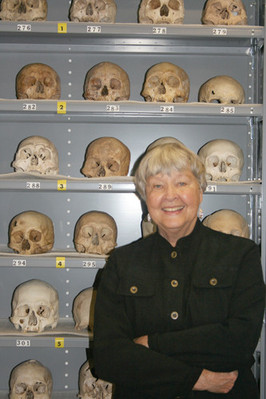
When grade-schoolers follow painted footprints past displays representing millions of years, the San Diego Museum of Man is sure to tap a curiosity and offer an adventure in learning.
It’s extremely gratifying to curator Rose Tyson, who for over 36 years has been the physical anthropologist and organizer of priceless exhibits in this version of a time machine.
On April 19 she had just completed a seven-day labeling project and was preparing to “package” a vast collection of Peruvian bones to the University of California, San Diego.
The labels were for a new main floor display she just completed with artifacts from the 91-year old onetime California exposition building. The arm and leg bones, given to the museum by Stanford University, will be studied by radiologists.
The museum’s west wing is home to extensive anthropology exhibits such as “Footsteps Through Time: Four Million Years of Human Evolution.” The exhibit covers 7,000 square feet and features five galleries filled with more than 100 touchable replicas of early humans, primates and futuristic cyborgs (part human, part machine). It even includes a section on stem cell research, cloning and DNA.
Tyson, who obtained a master’s degree at San Diego State University, said she is interested in human evolution and how diseases affect the human skeleton. She pointed out some deformities from dozens of arm and leg samples.
As one of three curators there, she is responsible for all exhibits on the main floor.
“My first large one [show] was in 1981,” she said. “It was a large physical anthropology [exhibit] called “Body to Bones.” It was popular but it took up the entire main floor with walls and cases. The main floor is more open now and beautiful.”
The building itself is a San Diego treasure and city symbol with its tile-capped tower designed in 1915 by Bertram G. Goodhue.
It is home to 70,000 artifacts, folk art and archaeological finds from all over the world. With mummies and ancient carved monuments, the treasures inside are abundant.
Edgar Lee Hewett of the School of American Archaeology (now School of American Research) was appointed designer of the central exhibit “The Story of Man through the Ages.” Ales Hrdlicka of the Smithsonian Institution was engaged to collect specimens for the most comprehensive physical anthropology exhibit ever assembled.
Expeditions were sent to Alaska, Siberia, Africa and the Philippines. European museums provided important casts and photographs of early man fossils. From Peru, skeletal material and rare trephine skulls were collected.
“When the Panama-California exposition (1915-16) was over, all the 5,000 artifacts were retained for a new museum, which became the core to our collection,” said Tyson, who was born and raised in Oceanside and Vista.
“The main parts of it are pretty much the same,” she said. “As we grew, we couldn’t keep collecting from the entire world, so we switched to Man in the Western Americas. All along the West Coast.”
According to Tyson, the children are partial to the two Egyptian mummies on loan from the Los Angeles County Museum. She also noted that Ellen Browning Scripps, who generously donated to various causes in San Diego, funded the Egyptian Exploration Society.
The museum is well supplied with help. There are 35 on staff, 40 to 50 volunteers and student interns.
Although Tyson, 71, has no children, she certainly has enriched the lives of so many young people over the years as a curator and college professor at University of San Diego and SDSU.
“Been working seven days and nights to prepare the labels [for the new exhibit] and only had a month to do it,” she concluded. “Think my husband and I will be free this weekend to take the camper and go someplace.”
Coming this summer to the San Diego Museum of Man, Art and Expression: the Legacy of Our Collections opens to the public on May 12, 2007. A new exhibit, “Artists Speak,” features painters and sculptors from Ghana and Zimbabwe. Opens May 12, 2007. “Journey to the Copper Age” opens June 10, 2007. Tickets for this landmark exhibit are available now, and may be purchased online. For more information on all of the museum’s exhibits visit www.museumofman.org/html/exhibits.html.


