


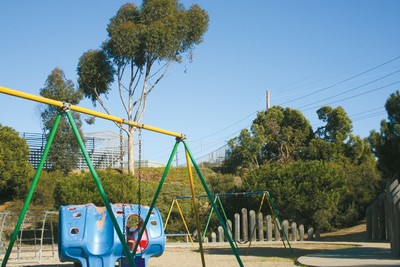
Once again, a small group of parents turned out Jan. 24 to discuss the toxic substances buried underground at Correia Junior High School on Valeta Street. School officials and representatives from the state Toxic Substances Control Department, which is advising the district on the matter, addressed questions regarding the cleanup plan for the burn ash that was discovered on the campus in 2003.
The first such meeting, held in October 2006, was also poorly attended. But Dave Umstot, interim chief facilities officer for the San Diego Unified School District, considers that a good thing.
“Most of the parents that I’ve talked to won’t be here tonight because they don’t feel the need to be concerned,” Umstot said minutes before the meeting, looking around the near-empty auditorium.
However, the parents in attendance did have some concerns.
The burn ash “” the result of trash burned at the site before the school’s construction in 1958 “” is present beneath 2.5 feet of clean soil at the southern end of campus under the playfield used for physical education and along the slope reaching down to Famosa Boulevard.
Parent Rachel Kennedy raised concerns about the slope, including where it reaches down into Bill Cleator Community Park, which also contains burn ash under the surface, according to Umstot.
Kennedy admitted that she was not initially concerned about the issue when her son brought information home. However, when her son suffered a serious asthma attack during the school year, forcing him to stay home from school for three days, she became worried.
“He hasn’t had any problems for three years,” Kennedy said. “He didn’t even need medication.”
Kennedy said she questions whether there have not been enough samples from the slope area to ensure that burn ash is also not present on the surface. Unlike the level playfield, Kennedy fears that burn ash under the slope, which cuts the soil horizontally, could become exposed through erosion.
According to the fact sheet handed out at the meeting, 130 soil samples were collected from the slopes along Valeta Street and Famosa Boulevard as well as the playfields.
Umstot, along with Bill Bosan, a toxicologist with the Department of Toxic Substances Control, assured Kennedy that currently there is no burn ash present at the surface of the slope, but they did say that erosion is a valid concern.
While the removal plan does not necessarily entail physically removing the contaminants, it does address potential erosion by recommending further capping of the area with clean soil. Erosion is a slow-moving process, and exposing the burn ash could take years.
The removal plan is tentatively scheduled for public review in February or March.
Rebecca Chou, Cypress branch chief for Toxic Substances Control, explained that the district is limited to the analysis and remediation of the soil on the Correia property only; therefore, the district has not studied the soil at Cleator Park, as that is the responsibility of the city.
But Chou assured that the state would work closely with the city and the district on remedying the problem at both sites once the city has completed a preliminary assessment of contaminants and exposure pathways for the park site.
The public will be notified for the public review of Cleator Park’s assessment when that is determined.
For more information on the school site evaluation, visit www.dtsc.ca.gov and click on the EnviroStor link. Enter San Diego as the city and select “School Cleanup Sites” to find the link for Correia’s report.


