


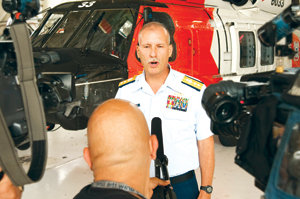
With the installation of a new, cutting-edge Rescue 21 search and rescue system, local boaters are now navigating safer waters. The U.S. Coast Guard Sector San Diego unveiled the technologically-advanced system at its headquarters in a ceremony Oct. 21. “It’s very cool for San Diego because we’re a community on the water, and this way people know that they can feel secure that if … they get endangered, we now have the ability to find them quicker,” said Rep. Susan Davis, 53rd Congressional District, who attended the ceremony. Currently covering 36,000 miles of coastline nationwide, the $1 billion Rescue 21 system now covers 167 miles in Sector San Diego — which includes San Diego and Imperial counties, Arizona, southern Nevada and southern Utah. Rescue 21 replaces the National Distress Response System that has been in place since the 1970s. “It’s very important because anyone that gets in a boat or a ship and sails the water — even with the best preparation, things can go wrong,” said Rear Adm. Ronald Rábago, U.S. Coast Guard assistant commandant for acquisition. “This system allows, with very little effort on the part of the boater or the mariner, to call distress and then have the confidence that someone is going to come out and rescue them.” Rescue 21 is a network of high-frequency radio antennae and two-way receivers combined with advanced direction-finding technology that can detect and locate distress calls to within a 1.5-mile radius. The system, designed by General Dynamics C4 Systems, also provides increased voice clarity, records emergency calls and detects hoax calls. “The radios we have are state-of-the-art and they are very sensitive. They can pick up a boater in distress signal from 20 miles or more offshore,” said Lee Wright, senior director of National Communications and Homeland Security for General Dynamics. “The system has sophisticated electronics to pinpoint where that boater is within a few miles of their location, which saves the Coast Guard a lot of time and resources in locating them.” Radio signals for Rescue 21 will be transmitted from three towers in the area — one at Point Loma, one at Santa Catalina Island and one at Camp Pendleton. Those towers are linked to the maritime international distress channel, VHF channel 16. “This system does it all in a digital way, plus it has backup systems and it uses a network so that we can manage the whole system,” Rábago said. “It is leading-edge technology and, coupled with new radios and other capability, it really does enable us to keep our waters safe and respond to distress calls.” Rábago said most boats already have the proper digital calling service in place. Boaters can connect to Rescue 21 with the simple push of a button. “It’s really simple. It’s digital, it’s push button; you really don’t have to know much, you just have to have it,” Rábago said. Rábago encouraged those with questions about the Rescue 21 system to have the local Coast Guard auxiliary conduct a safety inspection of their boat. The Coast Guard auxiliary is trained to talk about the new system. “They will do a safety inspection, a safety check for the boats, and advise them the best way to use the system so they can be safe,” Rábago said. For more information about Rescue 21, visit http://www.uscg.mil/acquis ition/rescue21.


