


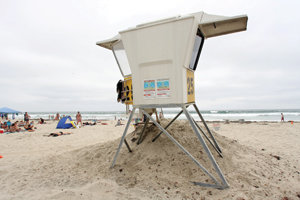
Potential plans to sell advertising space on public beaches have left a divided community in their wake, with some welcoming additional sources of revenue as the city’s budget woes worsen and some fearing that the move borders on desperation. Mayor Jerry Sanders’ Strategic Marketing and Advertising Plan stems from the city’s 1999 Corporate Sponsorship Program, and consists of acquiring one corporate sponsor for each of the city’s eight main lifeguard stations. Jenny Wolff, director of strategic partnerships for the city, said contracts would last five years and would each raise a projected $200,000 to $500,000 per year. San Diego Lifeguard Services Sgt. Ed Harris has worked as a guard for 22 years and is currently assigned to the La Jolla area. He clarified that he speaks solely on behalf of the 911 Teamsters representing the lifeguards. Harris said lifeguard services have suffered as a result of budget cuts and that the Teamsters fully support the mayor’s plan “and going even further” to secure additional revenue. “We understand the city’s in a budget crisis and we want to be part of the solution,” Harris said. “We’re not asking them to do anything unreasonable. We’ve come up with funding sources and we’ve asked that they take the revenue from those sources and put it back into the services.” The city employs about 80 full-time lifeguards and 180 seasonal lifeguards following a cut that eliminated 12 percent of the full-time staff, Harris said. All guards typically work 40-hour weeks, and Harris said that the department recently implemented a mandatory overtime policy. “We’re facing pretty drastic cuts and we’ve virtually eliminated the most meaningful training,” he said. “We’re just stretched really thin.” Harris suggested that the cutbacks have weakened the lifeguards’ abilities to respond and are potentially making the beaches less safe. “For example, today we had two vacancies that we weren’t able to fill in La Jolla, so La Jolla’s going to operate with two fewer guards,” he said Monday. Those spots are supplemented with seasonal guards who are not authorized to help with law enforcement or perform cliff and scuba rescues, he said. Harris said the Teamsters’ marketing ideas included finding corporate sponsors for vehicles, uniforms and surfboards, buoys, trash cans, the surf report hotline and even the 8,000 to 10,000 Band-Aids the lifeguards distribute annually. “We live here, we work here and we’re part of the beach community,” Harris said. “We certainly don’t want to see anything that isn’t done tastefully or doesn’t respect the beach. But we would rather have a little bit of signage or advertising than see somebody drown.” Harris added that the Teamsters are also lobbying for a program that would reimburse lifeguards for their training at Miramar College. “We have tons and tons of ideas that will generate money, but we can’t implement them or see any returns unless they are approved and the funds are allocated to us,” he said. “We want to make sure the public signs off on these ideas so we can all see well-managed and well-maintained beaches.” Joe LaCava, president of the La Jolla Community Planning Association (LJCPA), said he plans to raise the issue at one of the group’s meetings around September. “I hope to have more information from the city so that we can understand specifically what they have in mind,” he said. Though LaCava acknowledged the city’s budget restrictions, he said the city should “explore a variety of ideas” rather than focusing on beach areas. “Protecting the parks and beaches from commercialization has long been a worthy goal by the city, the community and the Coastal Commission, so this effort has to tread carefully,” he said. LaCava also supported efforts to keep proceeds directed toward specific communities that host the advertising, as opposed to all revenue entering a general fund. “While I appreciate the city’s interest in reaching out to community groups, the test will be whether they listen to the community in tailoring the programs to each community’s unique needs,” he said. Erin Demorest, an aide for District 1 City Councilwoman Sherri Lightner’s office, said Lightner plans to gather more information about potential plans before the City Council votes on the issue — which will likely happen sometime this fall. “The plan is still in the early stages and we don’t know yet which beaches might be included, but it would likely depend on the feedback the mayor’s office receives from each community,” Demorest said. “Sherri will carefully consider input from the community before making a decision on whether or not to support the proposal.”


