


From all accounts, Georgi Melitonis dze Balanchivadze never failed to let everybody know where they stood, even if his outspokenness meant compromised feelings. And since he’d invested every fiber of his being in performance art, he was particularly frank about his fellow practitioners’ contribution to the field as he saw it.
“Most ballet teachers in the United States are terrible,” he once said. “If they were in medicine, everyone would be poisoned.”
Them’s fightin’ words, especially coming from a guy who didn’t even get to America from his native St. Petersburg, Russia, until he was almost 30.
But soon, it wouldn’t matter. George Balanchine was about to transform the face of American dance, compiling a nearly Shakespearean legacy admired by even the most bitter objects of his contempt.
It all started with his stark and lofty “Serenade,” a ballet set to Tchaikovsky’s “Serenade for Strings.” This was to be his maiden work in the United States, first performed in 1934 “” and it would mark the beginning of this country’s transition from the classical to the modern school.
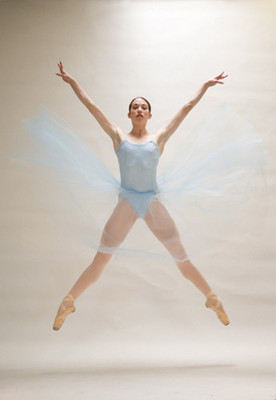
The City Ballet of San Diego is staging “Serenade” at the Spreckels Theatre, 121 Broadway, May 11 through 13.
It’s one thing that City has staked a certain claim to the piece “” the company is the only one in the region that the George Balanchine Foundation commissions to perform the master’s works. It’s another, said City artistic director Steven Wistrich, that the dance community holds the piece in such high regard.
“Many people in the dance world, including myself, consider ‘Serenade’ to be Mr. Balanchine’s best ballet,” Wistrich said. “Maybe that’s because he originally choreographed it on students. There’s a certain beautiful simplicity to it. As the ballet opens, the girls do synchronized movements that are in ballet terms quite simple, but they’re cleverly, brilliantly effective. You see 17 girls doing the same movement that ordinarily would seem very pedantic.
“Nobody moved that way in 1934. People just did not move that way, with these very contemporary, almost quirky movement qualities. It’s not just totally classical.”
There’s no storyline to the piece, Wistrich said “” but “it’s hard to imagine other steps more perfect for that music.”
Like the choreography, in fact, Tchaikovsky yielded to music’s less classical elements “” he drew heavily from Mozart and his Romantic tendencies, which often feature a certain delicacy and sensuality.
“Serenade for Strings,” Tchaikovsky wrote to his patron Nadezhda von Meck, “is my homage to Mozart. It’s intended to be an imitation of his style, and I should be delighted if I thought I had in any way approached my model.”
But for all its refinements, “Serenade” was reportedly conceived by the seat of Balanchine’s pants.
“He was kind of at the mercy of the dancers,” Wistrich said. “He did not have a company at the time, and he was working with students. He never even knew how many would show up. At the beginning of the ballet, there are 17 girls onstage because he only had 17 students at the time. One night, only nine showed up, so he conceived the next section for only nine dancers. That’s just where he was at the time.
“What’s so ironic is that, through all of that, it’s just such a work of genius.”
So often, Wistrich conceded, such greatness is lost on a public that finds it hard to comprehend dance’s mostly sensual appeal.
“Ballet is a hard sell in this country,” Wistrich said. “It’s much harder to sell than some of the other disciplines. It’s often misunderstood. And we don’t have an opera-size budget, like the San Diego Symphony, where they take out these huge full-page ads for weeks at a time.
“For us, it’s always been a challenge getting the word out and trying to let people be aware of what we’re doing.”
And that’s where Balanchine comes in.
Tickets to the program are $25 to $49; the box office phone number is 858-272-8663. More information about the program and City Ballet is available at www.cityballet.org.


