


Much has changed in music photography over the past two decades. Film has given way to the digital medium, but the biggest shift has been in the way an artist is chronicled. Today major artists are routinely photographed from first rehearsal to final ovation, but access is limited due to control by labels, managers and ad agencies.
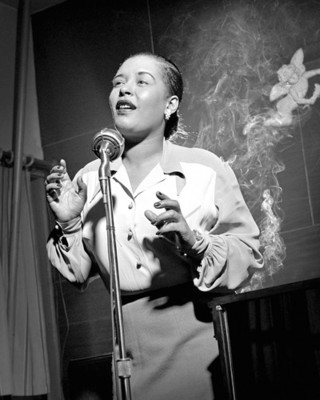
In past decades, however, taking photographs of musicians on and offstage was a less frequent and far more casual affair. Indeed, many classic images from the ’50s through the ’80s were shot by someone who also happened to be a fan of the artists. The result is imagery based not on the possible commercial value, but on the moment in music-making that it was capturing. Some of those vintage photos have become national treasures ” as is the case of those of lensman Herman Leonard, whose entire collection now resides in the Smithsonian Institution’s archives.
An exhibition of Leonard’s photographs will open at The Morrison Hotel Gallery on Saturday, Jan. 18. While his photography of jazz icons has had a huge impact on music fans, the initial reasons for Leonard’s love of photography are more earthly.
“There is no mystery why I became a photographer,” he said with a laugh. “At the age of about 9, I accidentally stumbled upon nude studies of my brother’s wife in his darkroom. It didn’t take me long to decide that this was to become my career.”
His discovery of jazz came through the radio.
“Since there was no CDs, Internet or television, my parents played classical music. But when I first heard Louis Jordan sing ‘Caledonia’ and ‘Let the Good Times Roll,’ my foot started tapping, something that never happened with Beethoven,” he said.
Born and raised in Allentown, Pa., he arrived in New York in 1947 and immediately set about capturing the music scene around him.
“I had the opportunity to see in person my icons,” Leonard said. “So, with the club owner’s permission I began to photograph the rehearsals, in return for which I gave free prints to the owners and musicians.”
He considers that, at least initially, it was the opportunity for free photos that opened doors for him.
“I never encountered any opposition as long as I remained silent and in the background,” he said. “For the most part, artists were cooperative, especially when they knew they would get prints. There were very few jazz photographers at the time so this worked very well.”
Though he has taken thousands of images in his lifetime, he can quickly name a favorite subject.
“Miles Davis,” he said without hesitation. “I believe I was one of the few photographers that connected with Miles, because for the most part he hated being photographed and interviewed.”
He is succinct on the reasons that made Davis such an appealing subject.
“It was impossible to take an uninteresting photo of the man,” he said. “His skin quality was like black satin and his piercing eyes left no doubt as to what he was thinking.”
His affection for Davis is evident in that he cites his later images, from 1989 and ’91, as personal favorites, but goes back decades to name others, including “Duke Ellington with Light Beams” (1958) and “Billie Holiday with Angel” (1949.)
Despite his entire collection of work now being in a museum, Leonard is still amazed by the impact his work has had.
“I’m surprised because it never occurred to me as I was shooting them that I was capturing musical history,” he commented. “I realize now that that particular period, early ’40s to middle ’50s, constituted a revolution in jazz led by Charlie Parker, Dizzy Gillespie and Thelonious Monk.”
He cited President Clinton giving a collection of his photos to King Bhumibol Adulyadej of Thailand as a career highpoint.
“That was huge honor to have my work selected to represent both the United States and the unique American art form, jazz,” said Leonard, who was happy to report that the two leaders’ love of music temporarily halted diplomatic discussions. “I was informed by the White House secretary that on presenting my pictures, the two of them held up the ceremony for 45 minutes discussing their views on the musicians, since the King is himself a musician. He plays clarinet and saxophone, as does Clinton.”
Now in his 80s, Leonard is still active.
“I’ve never stopped except for a slight interference by Hurricane Katrina,” he stated. “My subject matter varies from portraits to performance shots to still lifes to clouds or anything that strikes my eye as being interesting.”
He uses both film and digital to capture his subjects.
After more than 60 years behind the lens, Leonard is still enthralled with photography.
“It holds the same thrill and fascination for me as it did when I first saw an image appear on a blank piece of paper in the darkroom,” he said. “The camera for me is an ‘open sesame,’ giving me access to people and events that otherwise I would never experience.”
The Morrison Hotel Gallery, 1230 Prospect St., will host a reception for “Jazz Giants: The Photography of Herman Leonard” from 6 to 9 p.m. Saturday Jan. 18. For information, visit www.morrisonhotelgallery.com or call (858) 551-0835.


