


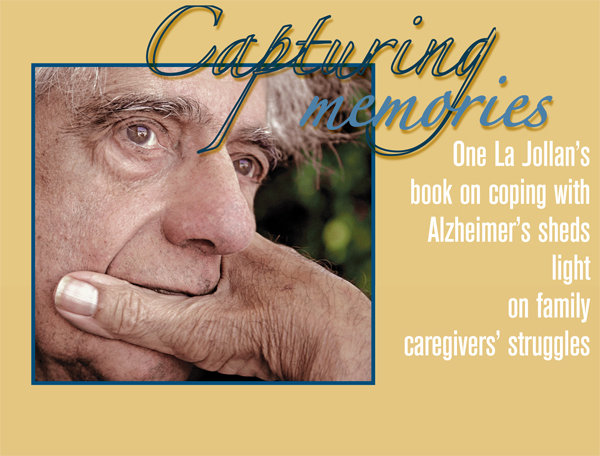
As a photographer with collections in galleries from New York to Los Angeles, Judith Fox had captured images of almost everything imaginable. She had taken photos of people, buildings, animals and trees — and every combination thereof. The one subject, though, that eluded her lens happened to be right in front of her. Other than the odd snapshot taken while traveling, she had never used her husband as a model. And ironically, in the end, she found in her husband, Ed Ackell, a most inspiring — if unlikely — muse. Fox, who has lived in La Jolla since the late 1990s, didn’t set out to document Ed’s struggle and decline because of Alzheimer’s disease. After coming across the photography book, “The Model Wife” by Arthur Ollman, in which Ollman compiles photos by nine photographers who used their wives as subjects, she wondered why there wasn’t a similar book called “The Model Husband.” Admittedly, she had never thought of Ed as a model, and she realized there was a serious lack of older subjects — male or female— in the art world, and even less focus on the male physique. “I had this opportunity to think about this aspect as an artist, and to build a series around my husband,” she said. When Fox started photographing Ed, he had been diagnosed with Alzheimer’s for a few years (the disease, in fact, had started showing up even before they married). Without any specific direction for her photos, Fox started documenting Ed’s daily activities — Ed sleeping, playing golf, eating, goofing around. After she had compiled a number of photos, she showed them to Ollman, who thought she had the makings for a book. It was only at this point, Fox said, that she started to consider how she might include the aspect of living with Alzheimer’s in the photo project. After all, the photos showed exactly that: Ed living with Alzheimer’s and doing — or not doing — all the things he had done before the diagnosis. Why couldn’t this stark portrayal of Ed’s daily life also double as a commentary on the disease? Ollman, however, discouraged her from taking that approach. “Arthur suggested I not bring in Alzheimer’s to the book because publishers don’t like to cross-market books and Alzheimer’s is a difficult subject to sell,” she said. “People are uncomfortable with it.” The more she thought about it, however, the more Fox said she rejected the notion that Alzheimer’s couldn’t — or shouldn’t — be talked about. “The more our journey went on, the more I realized how isolated caregivers feel,” she said. “At the time, Alzheimer’s was very in the closet. People didn’t talk about it. And I felt like I was in a position at that point to help contribute to the very beginnings of a conversation about Alzheimer’s and help people who are caregivers realize they’re not alone.” As it turns out, that is a common sentiment among those caring for family members with conditions like Alzheimer’s — that they must shoulder the burden alone. So much so that 25 years ago, a nonprofit organization was started up to help caregivers in exactly that situation. The Southern Caregiver Resource Center was founded with the goal of providing much-needed services, like respite, case management, counseling and support groups for caregivers who were stuck in the cycle of trying to do everything for their loved one themselves. Fox said she, too, was mired in this mindset. “I chose not to give myself permission to have day off for eight years,” Fox said of caring for Ed. “One of the difficulties of caring for someone with Alzheimer’s is that it’s a constant job. If you’re vigilant and a worrier — and I’m both — you’re always trying to anticipate what could go wrong and you’re always on watch. It’s a very difficult state to sustain.” Fox finally did allow help to come in, and though it was difficult to relinquish some control, she said, it was the best thing for her — and Ed — at that point. “I’m not patting myself on the back for waiting eight years. I waited too long,” she said. “I think that we, as caregivers, are very reluctant to admit we can’t do it all ourselves.” One of the reasons it can be so difficult to give up control — and one of the reasons Alzheimer’s is so difficult to live with — is the amount of uncertainty surrounding the disease, Fox said. With no clear introduction or indicators, Alzheimer’s, she said, “rolls in like a fog.” “It’s a very difficult disease, very slippery,” she said. “When someone has cancer, for example, you can see it on an X-ray. It’s something you can put your hands on, it’s tangible. But the nature of this disease is very mystifying. “There are moments of extreme lucidity, even now for Ed,” Fox continued. “You’re always questioning yourself, thinking, ‘I’m having this great conversation with this person. Is the diagnosis correct?’ Anyone who’s a caregiver is on constant roller coaster. We want to hope as human beings.” It’s that hope that Fox is counting on to help bring Alzheimer’s into the spotlight. The problem, she said, is only getting worse as the population ages and pretty soon, we may find ourselves in a tight spot. “As global society, we’re not even close to being prepared for the tsunami of Alzheimer’s that’s coming,” she said. “As a society, we’re not even dealing with current reality. We will be under water soon. One of my hopes is that as people understand how huge our needs are and what Alzheimer’s really means to us all as individuals and families and communities, they will start to do something about it.” In that spirit, Fox will be the keynote speaker at the 25th anniversary celebration for SCRC on Feb. 11 at the San Diego Marriott Del Mar. Since her photo book depicting Ed’s life with Alzheimer’s, “I Still Do: Loving and Living with Alzheimer’s,” was published in 2009, Fox has spent a lot of time traveling around, advocating on behalf of Alzheimer’s research and the needs of caregivers. In San Diego, she said, we’re relatively lucky to have institutions doing research, like the Salk Institute and UCSD’s Alzheimer’s Disease Research Center — one of the first in the country — as well as organizations like SCRC to help caregivers lay the course for dealing with conditions like Alzheimer’s and associated dementias. Marianna Randolph, a licensed clinical social worker and family consultant at SCRC, said she sees the necessity in finding a support system when dealing with sick loved ones. “Aging and caregiving are complex worlds and [SCRC] helps family caregivers navigate through their journey,” she said. “It’s hard. No one gives you clear-cut answers. Sure, there are books on caregiving, but each caregiving situation is unique and it helps to know that you can call a professional who is going to help you find options related to your specific situation.” For Fox, Ed’s situation resembled a slow slide, and her photos depict the ordinary struggles of the everyday. Ed shaves at the mirror, smiles coyly at his wife behind the lens, sits alone in a courtyard, soaks up the sun on a rock. In some pictures he seems distraught, in others carefree. The photos show the mundane details of life — Alzheimer’s or not. “It’s important to realize that people with Alzheimer’s still have lives,” she said. “Though their lives become increasingly narrow.” As Fox photographed Ed, she said, their bond grew deeper. The lens, rather than creating a barrier between photographer and subject, served to unite them in their shared experience. “It was an additional way of partnering with Ed,” she said. “We did this together, for as long as he could understand it. It was actually a lot of fun. More than a catharsis, it was another way of loving him, respecting him and acknowledging him. Ultimately, it will be more important as time goes on. It’s a way for me to keep my memories, as well.” A couple of years ago, Fox moved Ed into a fulltime care facility close to their home. She visits him regularly, and while the lucid moments are becoming fewer and farther between, the love between them, she said, is still there. “We’re still able to communicate and have an exchange, but it has gotten and is getting increasingly limited,” she said. “I do a lot of interpreting. We can always hold hands and talk in simple terms.” The decline, she said, was impossibly difficult for Ed, whom she describes as a “brilliant man” — he was a doctor, pilot, academic and former president of Virginia Commonwealth University — when he wasn’t able to do the things he did before, like discussing politics with friends. She was mindful of how photographing him at his most vulnerable would make him feel, but when he gave her the go-ahead, she realized her book could be more than something nice to look at. It could provide, she saw, a narrative for those who can’t be inside the head of someone with Alzheimer’s. “Because Ed is articulate, I’m able to understand it better than I would otherwise,” she said. “It’s very painful. If you can imagine what it’s like to not be comfortable in your own skin, where your surroundings never seem safe or familiar. People with Alzheimer’s don’t feel grounded. Those of us who don’t suffer from it take that feeling for granted. Even if we’re having a terrible day, we understand why. We can trust the world around us, even if it doesn’t feel friendly. “That’s part of why I did my book — it’s important to talk about and get comfortable with it,” she said. “I’ve talked to people around the globe dealing with Alzheimer’s, and the issues are always the same. I know I’m fortunate that I have options, but I think very often about the millions of people who don’t have options and how incredibly difficult their lives must be.” Former First Lady Rosalynn Carter will be the honorary chair at SCRC’s 25th anniversary benefit, for which Fox will present the key address. The event will feature live music from Emmy Award-winning and Grammy-nominated artist Allan Phillips, a performance by professional salsa dancers, food and spirits from Arterra Restaurant and Lounge and a live auction. Tickets are $225 and can be reserved at www.caregivercenter.org or by calling Roberto Velasquez at (858) 268-4432 x114, or via email at [email protected]. For more information on Fox’s current photographic work, including her project, “Sea of Dreams,” for which she has photographed images from the same undisclosed La Jolla location for almost a decade, visit www.judithfox.com.


