


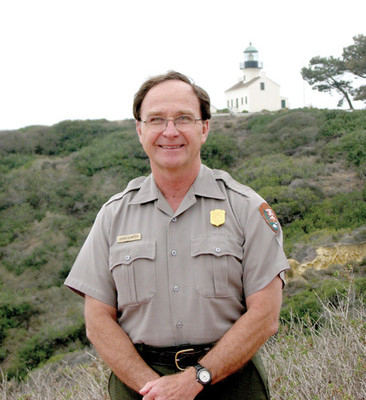
As San Diego’s only national park, Point Loma’s Cabrillo National Monument is a rarity.
Terry DiMattio also is a rarity. DiMattio is a National Park Service ranger who started and just ended his career at the same national park, beginning as a volunteer and retiring as superintendent, according to Jon Jarvis, regional director of the NPS Pacific West Region.
Although DiMattio, 60, rotated through three other parks ” as a ranger in interpretation at Whiskeytown National Recreation Area in Redding, Calif., as chief ranger at Fort McHenry National Monument and Historic Shrine in Baltimore, Md., and as superintendent at George Rogers Clark National Historical Park in Vincennes, Ind. ” he has spent 23 of the last 31 years with the park service in his hometown of San Diego.
On Sunday, June 3, DiMattio formally retired after 17 years as superintendent of Cabrillo National Monument. He began his career as a volunteer, giving interpretive tours and dressing up as 19th-century lighthouse keeper Robert Israel, in the uniform of the U.S. Lighthouse Service.
On Saturday night, 160 friends, relatives, current and former park service staff members and volunteers gathered at the monument’s visitor center to honor DiMattio during a dinner and moving tribute chock-full of emotion and laughter.
“Mentor,” “friend,” “teacher” were the most frequent words used to describe the respected superintendent, who, his staff agreed, had nurtured a comfortable and amicable working environment built on teamwork, trust and growth, resulting in low staff turnover.
“The tone of any park starts at the top and he set a wonderful tone,” said Karl Pierce, chief of interpretation at Cabrillo. “A lot has to do with Terry and his management style, the team he’s created around him. I think universally none of us wants him to retire, though we’re happy for him. But if we could, we’d turn back the clock.”
DiMattio says he wonders where the time has gone, looking back at a rich career as a park ranger. He considered becoming a teacher after serving with the U.S. Navy in Vietnam then earning a graduate degree in history from San Diego State University. The problem was, there were no jobs. Instead, he took the suggestion of Cabrillo National Monument historian Mary Bradford, who visited SDSU to talk about work as a park ranger. CNM had just launched its Volunteers in the Park program.
DiMattio signed up in 1972.
When then-superintendent Tom Tucker offered DiMattio a job as a ranger in 1974, DiMattio jumped at the opportunity. He spent the next six years at Cabrillo focusing on interpretation, a park service career track he pursued until his first superintendent job at George Rogers Clark National Historical Park.
He cherishes memories from his tenure at Fort McHenry, the only shrine in the National Park System, where daughter Jennifer’s bedroom window looked out onto a replica of the flag that inspired Francis Scott Key to pen the lyrics to America’s national anthem.
“One of the most moving moments at Fort McHenry was when the Welsh Men’s Choir came to the park and gathered around the flag. They sang ‘The Star-Spangled Banner.’ It sent chills down my spine,” he said.
After his years away from San Diego, he was eager to return home to Cabrillo. “We thought we’d only stay five years,” he said, referring to his 17-year-long stint.
The Cabrillo he knew as a young ranger and the one he took on as superintendent in 1990 were very different from today’s park, largely as a result of DiMattio’s leadership, according to co-workers. The monument was interpreted largely through its history relating to the landing in 1542 of Juan RodrÃguez Cabrillo at Ballast Point, the 1855 Old Point Loma Lighthouse and its military role in coastal defense.
“Cabrillo has changed remarkably. We’ve removed a lot of the exotic vegetation planted in the mid-’60s to restore the native habitat and to save water,” DiMattio said. Park service officials succeeded in eliminating the million gallons they were using annually to water non-native plants.
That was just the start of the changes DiMattio introduced, drawing on revenue from park admission fees, introduced in 1996. Eighty percent of the fees stay in the park to improve visitors’ experiences, park officials said. These were used to fund a new tidepool film, rehabilitate the landscape around the lighthouse, re-create the assistant lighthouse keeper’s quarters with its new exhibits, construct museum storage facilities, build the visitors’ contact office (nearing completion) and design the replacement whale overlook station and improved tidepool parking.
Trained as a historian, DiMattio points to his creation of the Natural Resource Science Division, which undertakes scientific research, and the Tidepool Protection, Education and Restoration Program as his proudest accomplishments at Cabrillo.
There was little focus on the landscape or terrain before DiMattio became superintendent, said Andrea Compton, Cabrillo’s natural resource science chief.
“It was his efforts that got it off and running. He obtained funding and resources and has been dedicated to that,” she said.
Jarvis notes that DiMattio is the rare superintendent able to complete every project in the 10-year plan developed for the park in 1996, transforming, restoring and upgrading its interpretive exhibits, trails, light station, accessibility and natural landscape.
“I look at Terry as the consummate park superintendent who’s been able to do it all in so many ways,” Jarvis said.
For DiMattio, it’s the people ” staff, volunteers and colleagues “” he will miss most.
“What really makes the difference where you work is the people you work with, the people who’ve done so much to support me and the park. That’s the hardest part about leaving,” he said.
What’s ahead for DiMattio?
“There are trails to hike, books to read, places to visit, fish to catch,” he said. Recently, DiMattio and wife Joanne purchased several acres of land in Victor, Idaho, with a view of his beloved Grand Teton National Park. They plan to build a home, and DiMattio hopes to volunteer with conservation organizations and help struggling readers master the skill.


