


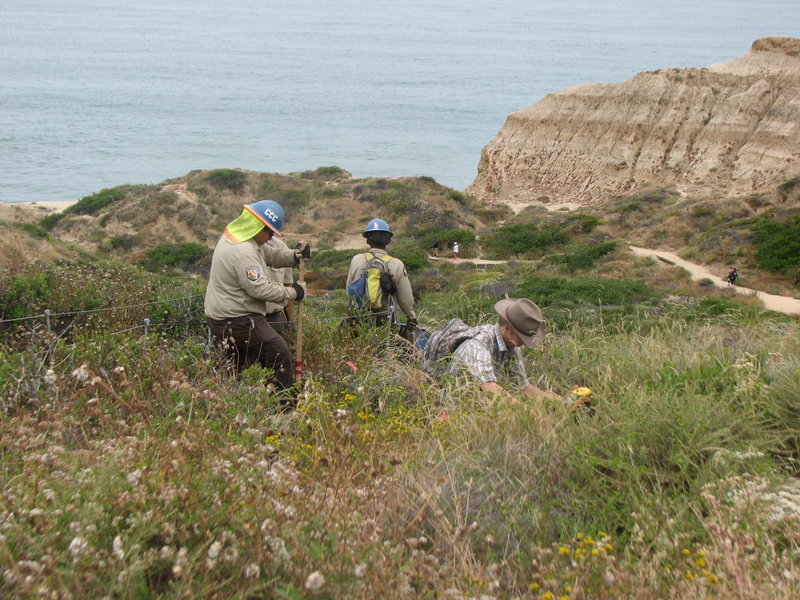
The trails of North Torrey Pines State Natural Reserve are some of the most frequented in Southern California. Displaying postcard-worthy vistas that bring throngs of gradient-defying runners, bikers and hikers, several of the trails remind one of why they pay California rent. With this past winter’s torrential rains, however, one of the most popular trails, the Broken Hill Trail, has faced some safety issues resulting from erosion. This deterioration is why the California Conservation Corps (CCC) have been hard at work since January working eight days on and six days off. When the La Jolla Village News went to meet up with the crew, comprised of men and women between the ages of 18 and 25, they were based out of Pomona and camping out on the beach below Broken Hill Trail. While having the privilege to camp in the Torrey Pines Reserve creates envy in most San Diegans, their strenuous labor is not for the faint of heart.
“Basically, the erosion was so bad on the trail, that it was deemed unsafe for public use,” said Dana Howard, communications director of CCC. “You’ll see the edges of the trails are eroding out, a lot of the stairs need to be replaced, and several parts of the trail need to be built back to an even gradient.”
The Broken Hill Trail is roughly one mile in length and is one of the few state agency maintained trails in San Diego that extends to the beach. Since the trails are too narrow (and unstable) and the CCC wants to have as little of an impact on the environment as possible, the crews are not utilizing any heavy machinery. Just wheelbarrows, picks, shovels and their bare hands.
This type of work is typical, and fits with the CCC’s self-deprecating motto “Hard work, low pay, miserable conditions… and more!”
“Last month they installed redwood stairs on one segment of the trail, which takes hikers down to scenic overlooks and ultimately the ocean,” said Howard. “This June, crews will be placing rock rip-rap along the trail that has been impacted by erosion from poor drainage. Several corps members will be hauling the rock in wheelbarrows, while others will use hand tools to shore up the cliffs with the rock, using dry stone masonry techniques.”
Although Howard says that they do not have an exact project completion date, the erosion mitigation should be completed within a year-and-a-half. Their modifications should provide them with several years’ leeway, though it cannot be certain exactly how long (or short) they will remain functional.


