


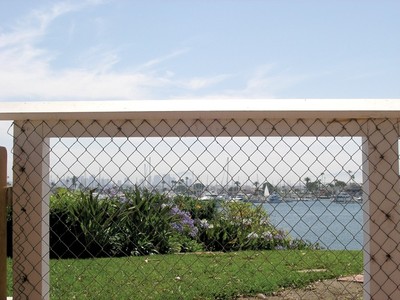
Six years after a complaint was filed with the city, a developed public right-of-way at the end of Nichols Street in Point Loma will be cleared of fencing and vegetation to make way for public access to the beach, city officials said Thursday, March 29.
City Attorney Michael Aguirre and District 2 Councilman Kevin Faulconer announced that two property owners have agreed to remove barriers and create a path between the street and the San Diego Bay below, with a sitting area and open space to enhance the view corridor.
“This will return a piece of history and heritage to the community,” Faulconer said of the property, which contains part of the historic La Playa Trail. City Council approved the settlement March 27, Faulconer said.
A fence between the homes at 2900 and 2905 Nichols Street as well as dense vegetation and landscaping have prevented public access between the dead end and the water.
The agreement “” reached Feb. 27 in mediation with retired judge Harry McCue “” puts an end to a two-year-old lawsuit filed by previous homeowners, who challenged the city’s claim to the land. Both residences have since changed hands, with new owners Todd and Stacy Sabin and Steve Games inheriting the legal battle.
Neither the Sabins nor Games attended the press conference.
The settlement dictates that the entire 50-foot-wide and 75-foot-long strip of land remains city property, though easements on both sides of up to 19 feet will be granted to the residents. According to Deputy City Attorney Malinda Dickenson, the city has the right to use the property in the future should it chose to do so.
Both Aguirre and Faulconer stressed the importance of the resolution because a successful lawsuit could have opened up similar beach paper streets, or unpaved sections of road, to development by adjacent property owners.
“There is no way to put a value on this,” Aguirre said.
The land in question has long been considered and used as a public corridor and is noted as such in the Peninsula Community Plan. But during the last two decades, various homeowners have fenced off the area and annexed the undeveloped space.
The violations did not get past neighbor Norman Magneson, a retired Navy civil engineer and community activist, who has stayed on top of the issue over the years.
“This was one that got in my craw and I wasn’t going to give up,” he said.
The first incident in 1991 was resolved after Magneson, 83, filed an official complaint with Neighborhood Code Compliance.
In 2001, then-residents Mark and Jan Barmann constructed a similar structure extending into the right-of-way. A year later, Metabolife founder Michael Ellis bridged the gap from his home on the other side.
Instead of acquiescing to requests from Magneson and the city to remove the fence, the homeowners filed a civil suit in March 2005.
The Barmanns sold their house to the Sabins shortly thereafter for $5 million, and Ellis sold his home in November 2006 to Games for an estimated $9.75 million, according to the county’s assessor’s office.
Six years, countless meetings and two new homeowners later, it appears that Magneson will again be able to walk from his home to the public beach yards away.
He said two factors influenced the conclusion of the lengthy dispute: new homeowner Games and a looming trial date in late March.
Magneson noted that Games purchased the property from Ellis with knowledge of the unresolved Notice of Violation and lawsuit and preferred not to spend large sums of money on lawyers.
Magneson and Games represented the city and the homeowners, respectively, in mediation in February, agreeing on a sitting area 25 feet wide (the length of the paved street) that extends 18 feet toward the beach. The width then narrows to 15 feet for a path with stairs traveling down the slope toward a sitting area with benches.
According to Magneson, the homeowners will pay for all construction and permitting costs and have until September to finish the agreed-upon improvements.
While Magneson can breathe a sigh of relief that the public looks to have beach access at Nichols Street restored, he says it’s not over yet.
“I’ll feel better six months from now,” he said.


