


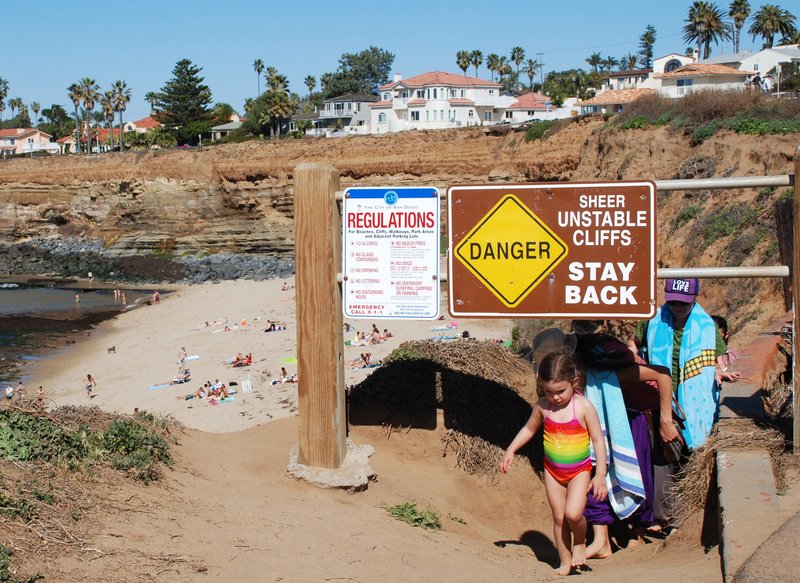
Race intensifies to halt slide, erosion of Sunset Cliffs From a distance, the bluffs at Sunset Cliffs Natural Park seem none the worse for wear, especially among those who like to take them in up-close-and-personal. Thousands of joggers, surfers, photographers, artists, birdwatchers and sunbathers have enjoyed the park’s urban and ocean vistas since at least 1926, when the city acquired the first of two chunks of land that make up the park’s 70 acres along the Point Loma Peninsula’s southwestern shore. But time has fueled an increasing dilemma at the park: the bluffs are actually in the middle of a slow crumble as waves pound them and as runoff from surrounding areas wears them away. This isn’t exactly breaking news. Regional pollution regulators directed the city to address the dilemma 20 years ago. Now, however, media outlets have been taking notice of the vanishing park. Last fall, Yahoo!’s Wanderlust website placed the park as the fourth most-rapidly disappearing attraction in America, ahead of Florida’s Everglades National Park. The bluffs are made of sandstone, porous enough to absorb water in large quantities without much effect. But strategically, even minimal erosion might lead to a much larger collapse of a cliffside, as has been the case in the past. As talk about solutions and options continues, the bluffs continue their slow descent, said one environmental watchdog official. “The cliffs, in their natural state, are fully capable of dealing with runoff, what we call incident rainfall,” said Julia Chunn-Heer, San Diego Surfrider Foundation’s campaign coordinator. “Where we see the problem is the run-on to the park. The runoff surrounding the park becomes the run-on to the park from the hard roofs and from the adjacent Sunset Cliffs Boulevard and from our drainage system. “When it’s clogged with debris, the water skips over it and directly onto the bluffs,” she said. “And right now, the parking lot is sloped toward the ocean, so all the water from that entire hard surface is concentrated to one area. The volume and velocity of the run-on is what’s causing the erosion.” The city has been aware of the erosion problem since 1992, when regional monitoring agencies directed the municipality to address an emerging pollution issue near the park shore. The agencies said the effects of stormwater compounded the erosion factor, which they linked to contaminants in the ocean. Then came the California Coastal Commission’s 2005 master plan, which urged greater efforts in drainage control. It criticized “[the] lack of a strong planning framework and a comprehensive systems planning approach,” which has resulted in “soils compaction, loss of native vegetation and erosion from uncontrolled bicycle traffic [and] undefined pedestrian traffic.” The numbers of visitors to the park are reportedly not recorded by the city. Meanwhile, the city commissioned a drainage study in 2006 and will conclude it within the next couple of months, with an eye toward piping the cliffs. A series of drainpipes near the base of the bluffs would route the water toward the ocean in hopes of stemming the erosion. City associate civil engineer Paul Jacob, who is managing the study, said the drains would be designed to intercept the runoff upstream, preventing it from reaching the bluffs. “All the water that’s running off rooftops and driveways and roadways is all being focused along one narrow strip along the coast,” Jacob said. “That’s the problem. You’ve got an enormous amount of water focused on one small area.” The mitigation plan would cost about $10 million, most of which would go toward construction. Jacob said the city’s stormwater manual guides its engineers to solutions the study will call for — but Chunn-Heer cautioned that those fixes might cause further incursion onto the area. “I think they’ve discarded how much green solutions can do,” she said. “The city wants to go in and build concrete structures that erode the cliffs further, using classical methods with concrete and pipes and getting the water off the land as fast as possible, instead of trying to mimic nature as much as possible. But the idea of putting concrete pipes parallel to the coast with eroding cliffs around is kind of counterintuitive. That’s where we have our differences.” Instead, Chunn-Heer said she believes the installation of natural vegetation, drainage courses designed to remove pollution from run-on, redirection of gutters away from the park soil and low-impact development plans would be more appropriate. “These would allow the cliffs to behave in a more natural scenario,” Chunn-Heer said. “We like to say, ‘Slow it down, spread it out, sink it in.’” Jacob said the natural scenario in and of itself, however, may be ineffective. “These solutions are great,” Jacob said, “but [environmentalists are] proposing a naturalized solution in an unnatural environment. All along the park, you have an urbanized watershed. When it rains, you have a lot more water coming down toward the bluffs than would have ever occurred in its natural state, when it was just brushy hillsides. The whole notion of natural [redirection] is good, but that would be inadequate to handle the volume of runoff we have to deal with. There’s just too much water.” Jacob said the runoff from the developed areas along Sunset Cliffs Boulevard is two to three times that on the undeveloped hillsides to the south. The city, he said, has never calculated the runoff ratio from the neighborhoods’ predevelopment state until today. Tomorrow, however, is another matter. Amid budget crises, bureaucratic entanglements and what Chunn-Heer calls “lack of impetus,” another waiting period may precede the study’s release and the first visible signs of a remedy. “That’s the $64,000 question,” Jacob said. “Clearly, the last couple of years, we’ve had such severe budget problems that it’s difficult to get anything built. But it’s not always going to be like that. “I would certainly expect the future to be a lot more promising than the last couple years have been,” he said. “But having said that, it does take a long time to get these projects built. It will take longer than anybody wants it to take.” Mitigation has already taken 20 years. Environmental advocates said they hope the solutions for preventing Sunset Cliffs Natural Park’s crumble does not take 20 more.


