


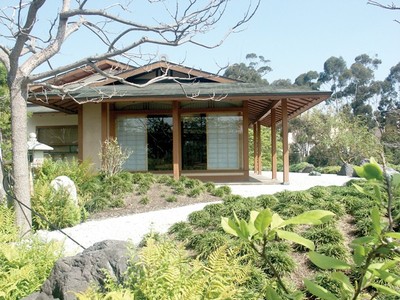
A serpentine walkway through the serene and beautifully landscaped Japanese Friendship Gardens has been projected to eventually continue on an expanded journey into a little canyon known as Gold Gulch.
An ambitious $12 million fund-raising campaign is well underway to broaden this Balboa Park area to 11 and a half acres, accentuated by a fascinating waterfall. Currently, the popular garden, located near the Organ Pavilion, covers two acres.
“On the expansion program, we have to have the proper designers, particularly to build a teahouse,” said Thelma Press, a board member in charge of academics. “We are hoping a Yokohama garden will send us the type of wood we need to build the teahouses. We want to make sure we have the best.”
Although the capital expansion program has just begun, $3 million has already been contributed.
Included in project plans will be a vertical and rapid waterfall streaming into a Lotus pond, symbolic of a dragon. Also included are camellia and azalea gardens, 150 cherry blossom trees, two teahouses and a 300-seat amphitheater. There will be another entrance at the lower level.
The area will be powered by solar energy.
The Japanese Friendship Garden Society of San Diego had its roots in the 1915 Panama-California Exposition. After the Exposition, strong community interest kept the Japanese Tea Pavilion open for 30 years within Balboa Park, San Diego’s culture center.
“The Friendship Garden was started in the present location in the 1990s,” said Lovelynn Hansen, events coordinator.
The formation of San Diego’s Sister City relationship with Yokohama in 1957, one of the oldest such relationships in the United States, spurred construction of the garden as a physical representation of these bonds.
Along the garden’s winding paths are a Zen garden for meditation, an exhibit house, koi pond, bonsai exhibit, ceremonial gate, and a fujidana (wisteria arbor).
There are 13 working members on the board and a membership of 500.
“People come from all over to visit the garden,” said Press. “One woman from Los Angeles said she had terrible headaches but didn’t once she came into the serene gardens.”
“[It’s] very spiritual and peaceful,” said Hansen. “People meditate by the koi pond, which is shaped like the island of Japan. They come in to paint, take photos. And we have over 100 weddings throughout the year, starting in March.
“From Memorial Day to Labor Day we’re open every day from 10 a.m. to 5 p.m. We have a restaurant which is leased out to the Prado.
“We are kinda tucked away. But people are generally lined up to get in at 10,” said Press. She added that the garden is the fourth most popular facility in Balboa Park.
“People donate screens, dolls, lacquerware and statuaries,” said Press.
The garden hosts a hands-on garden workshop each spring, allowing students to construct various components of Japanese gardens under the tutelage of some of the world’s most esteemed Japanese master gardeners and master designers.
The first phase of the present garden was opened in 1991 and the second phase in 1999. The construction fund program began in 1981.
Takeo Uesugi is the current garden designer, a professor of landscape architecture at California State University, Pomona. Ken Nakajima completed the first phase.
Basic elements of trees, shrubs, rocks and water were designed for natural balance.
The mission is to establish a Japanese-style garden with educational programs that will produce an understanding of the Japanese culture.


