


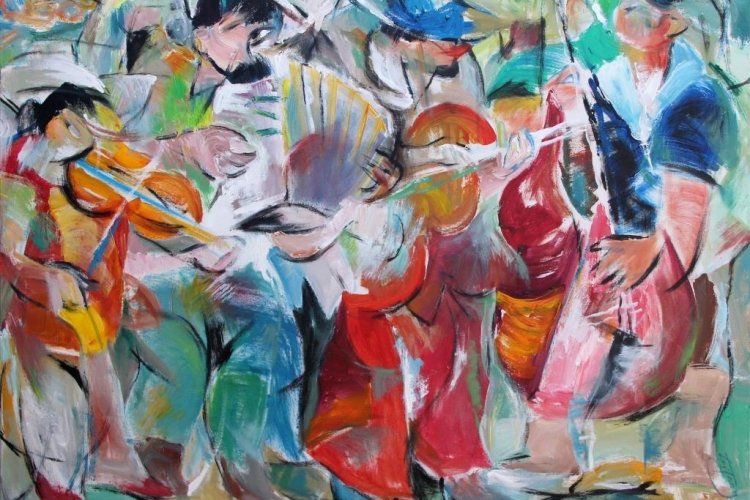
Chinese calligraphy tends to denote clean, definite characters – created through a constant, fluid motion. When one thinks of this form of calligraphy, however, bright colors and the human form do not directly come to mind. Artist Lei Tang was born in China and attended university in Beijing. Having received his master’s from the U.S. International University in San Diego, Tang absolutely fell in love with the area. Tang has found a way to combine the technique used in Chinese calligraphy with fauvism, a modern art movement championed by Henri Matisse. Fauvism favors a balance between light and color, as well as natural or human form. Though referred to as “the wild beasts,” this movement truly exemplifies the illumination of the everyday. This is reflected in Tang’s most recent collection, “Conducting a Symphony,” which will be displayed through March 4 at the Monarch/Arredon Gallery. The gallery will be hosting an artist reception for Tang on Saturday, Jan. 28. “Conducting a Symphony” focuses on the human form in a more abstract way than Tang’s past work. His interest in the female form shines through, as per usual, but many of the pieces cover social settings seen in Tang’s use of layering. Utilizing acrylics, Tang is able to create layers of color unimaginable to most. “I tried to work with oils, but it is by far the most difficult form to master,” said Tang. “Acrylic dries much faster, so I am able to use my layer technique to create color division/complements.”
Tang says he begins with a rough idea, which leads to a primary drawing. Typically, a painting takes him an entire day, but if he feels that his work is veering too far away from his original idea, he will take a break and return when ready.
“These colors correspond with my emotion at the time, which, like all sensations, can vary,” he said. “People want to look at abstracts and say ‘I can do that.’ That is not true. To work with abstracts, one must have a lot of training. There needs to be an interplay of movement and primary colors, without being distracting.” With all of his formal education, Tang strays away from rules. Like many things in life, repetition and routine can take a back seat to enjoyment from time to time.
“I dropped all the rules,” Tang said. “It is enjoyable to practice and master something, and originally some movements may look like dirt, but together – they’re beautiful.”
When viewing works from “Conducting a Symphony,” it is obvious what the artist wants to convey at a representational level, however, one’s mind will shift to the abstract emotion simultaneously. Tang has found a way to combine the spirit of a western art movement with the discipline and technique found in Chinese calligraphy. The artist, amiable and of a cheerful demeanor, carries this sentiment into this collection – a celebration of light, feeling, and color.


