


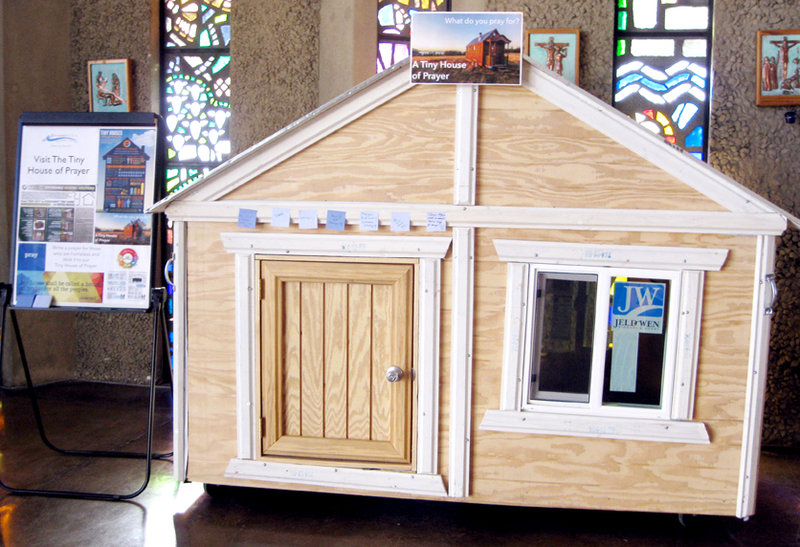
A Pacific Beach inventor and a church rector are promoting one conceivable solution to the intractable problem of homelessness: IKEA-like tiny, build-it-yourself homes. Rev. Dr. Simon Mainwaring, rector of St. Andrews by-the-Sea Episcopal Church in Pacific Beach, and Christopher Scott, who’s designed and built his own version of a “tiny” home, have teamed to popularize the concept. They’re calling it “the start of a real solution to San Diego’s homelessness problem.” “A kit for these 400-plus square-foot homes can be purchased for $500 or $600 and can be assembled in two or three hours with screwdrivers and without power tools,” said Scott, a forestry specialist who said he helped start IKEA, a Scandinavian chain selling ready-to-assemble furniture, in North America. “The concept I hope may work in PB is that a jobless person can start off with one of these little houses, make improvements to it, make it look pretty, and resell it and build some equity for their next step up.” Mainwaring, among five local PB church leaders who’ve banded together since November of 2015 to form the Pacific Beach Homeless Coalition, said Scott’s creative solution to finding the homeless homes is way of stimulating “thinking about homelessness and potential solutions. “We are looking at this as a way of sparking the imagination,” said Mainwaring, who discussed the tiny homes concept. “That’s the key, providing someone with a roof over their head in a location that provides stability and security, in their own little home where they can even close and lock the door, keeping them safely inside.” Once housed, an individual can then reboot his or her life, beginning the process of finding a job and re-establishing himself as a contributing member of society, Mainwaring said. One of Scott’s tiny home models is presently on view in St. Andrews sanctuary at 1050 Thomas Ave., across the street from Pacific Beach library. The tiny homes, which resemble children’s playhouses in design and appearance, are large enough for a medium-size person to stretch out or even stand in. “The whole country is seeded with people who are trying to approach it (homeless housing),” Scott said. Seattle has opened 14 tiny homes. A Nashville church has built six. The tiny homes are said to offer these advantages: • They provide better shelters than tarps or tents.
• The homeless can build them themselves.
• Wasted building materials can be collected to make the tiny homes, which adds an element of sustainability to them.
• Often, tiny homes can be grown to make them a more permanent form of housing.
• They’re extremely cost effective. Tiny homes will be on the agenda of the next Pacific Beach Homeless Coalition meeting, to which the public is invited on Wednesday, Feb. 17 from 11:30 a.m. to 1 p.m. in the Community Room of Pacific Beach Taylor Library, 4275 Cass St. “It’s a group meeting between neighbors, the homeless and other interested parties,” said Mainwaring, noting the format is mostly informal. “It’s a chance for people to build relationships, offer feedback,” he said. Mainwaring said the next step in the process of paving the way for the homes to become a reality is to “get neighborhood buy-in on the concept before working up a comprehensive proposal to bring to the city, then have an informed discussion.” Obviously places would have to be found, and in some cases zoning changed, to make tiny homes legal. “It’s a challenging solution to what is a profoundly challenging life to lead on the street,” noted Scott, who added that dialogue about homeless housing “is a great conversation to have.” Scott pointed out that tiny homes are trending. “It’s a solution being considered across the country and, frankly, the world,” he said, adding, “If we can put a man on the moon, we can find a solution for this.”


