


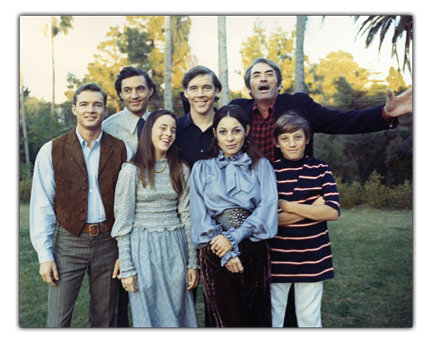
The Gregory Peck Centennial Celebration and Gregory Peck Award for Excellence in Cinema will be given at the San Diego International Film Festival Night of the Stars Tribute next Thursday at MOCA. This star-studded tribute will go to multiple award winner and one-time San Diego resident, Annette Bening. Created in honor of Peck, with the support of his family, this award is given to an individual whose work has made a profound impact on the art of cinema. Co-hosted by notable film critics Jeffrey Lyons and Ben Lyons, this glamorous event gets up close and personal as the San Diego International Film Festival honors some of the industry’s most accomplished actors, directors and filmmakers. (For more information on this special evening visit http://www. sdfilmfest.com/night-of-the-stars-tribute-2/) Gregory Peck. The legend, born 100 years ago, revolutionized the silver screen. Talented and handsome, pioneering and determined, Peck epitomizes the golden-era of Hollywood. Yet he also makes the Jewel of La Jolla sparkle with particular pride. Born Eldred Gregory Peck in April, 1916, in La Jolla, the multi-talented Peck wore many hats before becoming an actor. According to Wikipedia.org “Peck attended San Diego High School, and after graduating enrolled for one year at San Diego State Teacher’s College, (now SDSU). While there he joined the track team and took his first theatre and public-speaking courses. But Peck had ambitions to be a doctor and the following year gained admission to UC Berkeley as an English major and pre-med student.”
However, after being encouraged by a Berkeley acting coach to consider the craft, he appeared in some plays, and the rest, as they say, is history. Standing 6’3, Peck was a commanding presence who had an obvious flair for attracting attention and turning heads.
His talent and skill took him through multiple stage and film roles eventually leading him to his unforgettable role as the Southern lawyer, Atticus Finch, in To Kill A Mockingbird for which he earned the Best Actor Academy Award in 1962. The role seemed to mirror the man rich with convictions himself. “I put everything I had into it everything I’d learned in 46 years of living, about family life and fathers and children. And my feelings about racial justice and inequality and opportunity,” CNN.com reported Peck said of the role. His feelings were shared by many other influencers. In fact, in 2003, Peck’s portrayal of Atticus Finch was named the greatest film hero of the past 100 years by the American Film Institute. But long before this career-changing role, Peck was passionately involved in supporting theater where he first found his calling. Indeed, in 1947 Peck co-founded The La Jolla Playhouse with Mel Ferrer and Dorothy McGuire. The local community theater and landmark has attracted Hollywood film stars on hiatus both as performers and enthusiastic supporters since its inception and sits proudly as a beacon of acting-history inside UCSD. Ever the committed activist and independent man who did things on his own terms, Notable Biographies.com states, “Peck became one of the first stars to defy the studio system by refusing to sign with any single studio. He was also extremely careful in choosing his roles, trying to avoid typecasting himself. By the time he won his Oscar in 1962, he became one of the few actors with the power to command a million–dollar salary.” In 1969, U.S. President Lyndon Johnson honored Peck with the Presidential Medal of Freedom, the nation’s highest civilian honor. In 1971, the Screen Actors Guild presented Peck with the SAG Life Achievement Award. In 1989, the American Film Institute gave Peck the AFI Life Achievement Award. He received the Crystal Globe award for outstanding artistic contribution to world cinema in 1996. Here we offer a Q&A with Gregory Peck’s son, writer, Anthony Peck. LJVN:?Do you have any particular childhood memories of your father you’d like to share?
Anthony Peck: In the 1960’s when we were growing up, my father was not only making films, but he was very active with his humanitarian work. He was chairman of the American Cancer Society, founding chairman of the AFI, the president of the Academy, the chairman of the Motion Picture and Television Relief Fund, and more. He was busy to say the least! But when he was at home, he loved swimming in the pool with us, taking us to Dodger games, playing catch in the garden. He would have breakfast with us and then drop us off at school on his way to the studio. On weekends, our parents would take us to the beach with all of the kids and dogs in the station wagon. We’d stay into the evening and build bonfires and eat Kentucky Fried Chicken. At home he would set up an outdoor screen in the garden for us and our friends to watch movies under blankets. Our dad was involved in every aspect of our lives. The main memory is more of a feeling: he was always present for us, in every way. LJVN: Did you ever visit La Jolla with your father? If so, are there any memories of your time in La Jolla together that you’d like to share?
AP: When we were youngsters we would always come to La Jolla for two weeks in August. We would stay at the La Jolla Beach and Tennis Club. My father would take us swimming at the Cove where he swam as a youngster. We played Frisbee on the beach and had dinner at The Marine Room. We looked forward to it every summer. When I think of it, the time in La Jolla every summer was like something out of a dream it was so idyllic. LJVN: How would you describe growing up with your father? Was it an adventure or just the “average” childhood?
AP: I don’t think it was average but it felt normal. And, it was an adventure. We went wherever my father was working. I did a year of grade school in London when he was making “Arabesque” with Sofia Loren. Sometimes we would stay home and attend school in Los Angeles even when he and our mom were on location. But if he was shooting in the summers we went with him — we would set up home in Utah or Arizona if he was shooting a Western, in Switzerland, once in Poe, at the foothills of the Pyrenees. When I was 16 my dad produced the movie “The Dove,” which was shot all over the globe. He took me for a month of shooting on location in South Africa, Mozambique and Australia. Then, I stayed home and he took my sister Cecilia on the next leg of locations in South America. As a child you’re not conscious that your life is different, he’s just your dad. As a teenager, I started noticing that my people treated my father with great respect and deference. We not only had an extraordinary father, we had an amazing mother too. Our mother Veronique was our dad’s true love, his other half, his partner and equal in every way. She was brilliant, witty and beautiful, and she would create lively gatherings with the most extraordinary, interesting and artistic friends. Frank Sinatra coached me on singing techniques at Italian restaurants from New York to LA. It was pretty special. LJVN: What is the significance of his role in the La Jolla Playhouse?
AP: My father founded the La Jolla Playhouse in 1947 with his friends and colleagues Mel Ferrer and Dorothy McGuire. He had started as a stage actor and never lost his love and respect for the theater. He studied acting at the Neighborhood Playhouse, did several Broadway plays and was called to Hollywood. When Gregory founded the La Jolla Playhouse it was a way of being of service to his home town, of offering the nearby Hollywood actors a place to keep tuned on the boards and of maintaining a connection to the theater. He and Mel Ferrer actively ran the theatre during its first seasons, and appeared in productions there. He always spoke of going back to the theater, and in his later years he did, performing in a wonderful, one-man evening of storytelling. My sister made a very personal film about it, called “A Conversation With Gregory Peck.” It is as uplifting a movie as I know. LJVN: What are a few of the attributes that make Bening the ideal recipient of this award?
AP: Annette Bening is a superb example of an actor with a world class craft. Annette started her career on the stage and developed her technique and her artistry performing great classical roles before her transition to film acting. Those years on the stage are invaluable to an actor. You can hear it in Annette’s voice, you can see it in her relaxation, you can feel it in her confidence. When she is on the screen you know you’re in good hands. Nothing is going to go wrong and you are going to be surprised, enlightened and deeply moved. My father loved Annette and her work. They also have in common both being San Diego-area natives! He would be so pleased to know she is receiving the award that carries his name. AP: My father followed his heart. This is how he lived his life, how he chose the roles he played and the causes with which he got involved. And, his heart was to help others, to entertain and provide insight, to set an example, and to stand up for his beliefs through story telling. By following his heart no matter what the consequences might be, he was rewarded with a life of artistry and accomplishment. He is my example in every way. We created a website this year, to honor his centenary, it has a lot of biographical information and personal touches, including many photos from our family archives. I think your readers might enjoy it, it’s http://www.gregorypeck.


