


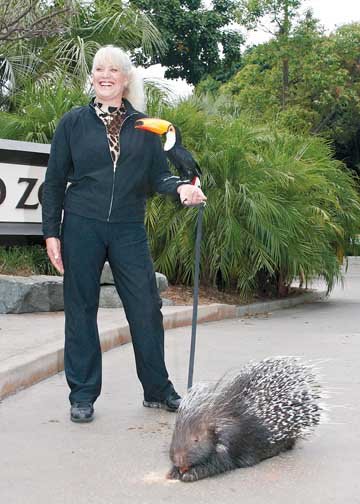
Amphibians hold the key to the challenges facing wildlife in Southern California, according to Joan Embery, who has left her Zoo goodwill ambassador’s duties to become a conservation authority. We talked one evening after she completed a full day of meetings, appointments and then attended to some of her 100 animals from A to Z, an aardvark to an endangered African zebra at her Lakeside ranch. “Amphibians are environmental indicators,” she said. “They breathe through their skin, are aquatic and sensitive to (habitat) change. So, when you see a large die-off of amphibians, you realize there is something wrong with the environment. “And we should be concerned,” she said. “Sort of like the canary in the coal mine.” Although the concerns are worldwide, the San Diego Zoo has established a research team to study changes in Southern California. Embery and her husband, Duane Pillsbury, have a 50-acre El Monte Valley ranch just off Wild Canyon Road, close to the banks of the San Diego River. Because of their constant work in the field, the San Diego Zoo recently awarded them the prestigious conservation medal. Embery, of course, can be remembered for her appearances on television, particularly the “Tonight Show” with Johnny Carson and Jay Leno. She has been a goodwill ambassador at the zoo for many years. “Those studio trips were three hours up and back, appearing in a studio with unpredictable animals and unpredictable show hosts,” she said. “You never knew what to expect.” Her work at the San Diego Zoo and Safari Park is not as extensive now but she is always on call. She refers to herself as the conservation ambassador. An article in the zoo’s publication Zoonooz detailed their continued activity with wildlife habitats in taking an active role with endangered species through breeding programs. “It’s not easy to get people’s attention,” Joan said. “But we hold the responsibility of sharing information and sparking interest in conservation.” Southern California, she said, is challenging because it has the highest diversity of wildlife in the nation — as well as the most rapidly growing human population. “So it ends up to be a real balancing act for natural resources,” she said. “[For example], the mountain lion is a balancing act. They’ll roam up to 200 square miles and their population is governed by available prey. “Setting aside a few acres here and there … is that sufficient? Their prey is primarily deer and deer populations are affected by habitat. Forage is needed to support a deer population.” Southern California’s biological diversity, Embery said, is the result of its unique topography — oceans, rivers, mountains and deserts, all within roughly 100 miles of each other. This has prompted close examination by conservationists. “In recent years a multifaceted team has been focusing on our backyard,” she said. “This work includes a study about the endangered horned lizard, kangaroo rats, red diamondback rattlesnakes and cactus wrens. The golden eagle population has plummeted, too. “Growth is a tipping scale where resources like water, fuel and timber are being used more rapidly than they can be replaced.” Meanwhile, she said, the zoo’s function is to maintain self-sustaining populations. As for her functions, she fills up her time quite easily. “I’m working all the time,” she said. “I run my own nonprofit, a lot of conservation-related work and educational programs.” She also visits children three times a week at a nearby school and is host to environmental groups at the ranch. As long as people are willing to listen, she has an important message to tell.


