


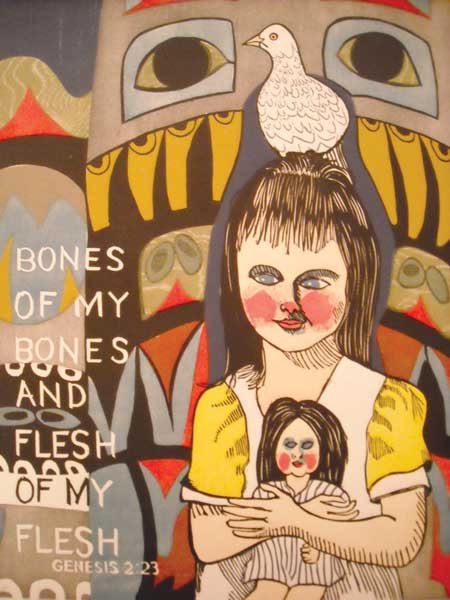
Clay Walker (1924-2008) might have become an American Picasso, but in the second half of his life when his career was approaching a zenith, he chose to withdraw into the life of a recluse, shunning the company of his contemporaries and turning his back on commercial success to make art for art’s sake, and showing it to nobody. Perry Meyer of Meyer Fine Art, 2400 Kettner Blvd. Suite 104, rediscovered Walker through Walker’s widow Muriel, who currently lives in the house Walker built in Vista. In the hopes of bringing Walker back into the limelight, Meyer became the exclusive distributor of Walker’s work. Meyer, who does not give evaluations of artists readily, said Walker is “one of the best artists in the country. He was way ahead of his time.” Meyer will be showing Walker’s art in two phases, in conjunction with the show “Pacific Standard Time: Art in L.A. 1945-1980.” Spearheaded by the Getty Foundation, Pacific Standard Time (PST), which will take place over the next six months, is a collaboration of more than 60 galleries all across Southern California, who are working together to celebrate, commemorate and archive the formative years of the Los Angeles art scene. The first phase of Walker’s showing at Meyer Fine Art will run from Nov. 11 to Dec. 24, and will exclusively showcase Walker’s work. The opening of the exhibit will run in conjunction with Little Italy North’s Nov. 11 “Kettner Nights” from 6 to 9 p.m. The second phase of the Walker exhibition will run from Jan. 1 to April 1 and will feature Walker, along with other prominent Southern California artists from the same period, like Barney Reid, Dan Dickey, Belle Baracean, Michael O’Mara and Allan Morrow. Meyer is joining other San Diego galleries — The Mingei, R.B. Stevenson, Museum of Contemporary Art San Diego and Loft99 — all of which are participating simultaneously in PST. A fascinating abstract artist with a wide range of interests, Walker’s work is sometimes defined by symmetrical design and pattern art characterized by rich colors, juxtaposed odd shapes and diverse patterns with clear, clean lines. A Native American influence in the form of north West Coast art can be found in his work, as can a strong tendency to use the landscape of the female body. Walker often created dark etchings, drawings and paintings featuring women who were somehow socially imprisoned or suffering the ravages of aging on their physical beauty. Another trend is the abstract landscapes denoted by blobs of color that splash up against each other with energy, movement and ragged edges. It is easy to wonder what an abstract artist like Walker is trying to say. “I don’t try to figure out what an artist is trying to say, you could never figure it out,” Meyer said. In his notes, however, Walker wrote, “My objective as a painter is to develop a significant means of seeking out, clarifying and interpreting man’s inner nature and the relationship of man to his environment.” Born in Middleboro, Ky., Walker was a descendent of Dr. Thomas Walker of Virginia, an explorer who helped discover the Cumberland Gap. When he was six years old, Walker’s family moved to Toledo, Ohio. As a child, he always had a sketchbook in hand and was interested in education. An infantry man who taught small arms and martial arts, during World War II, he was wounded and recovered in England, where he met his wife. In 1950, Walker earned a bachelor’s in painting from the University of Toledo and later a master’s from Kent State, with time spent studying at Oxford University in England and Ecole des Beaux Arts in Paris. In 1963, Walker moved from Texas, where he was the director of The San Antonio Art Institute, to Los Angles in order to join the art scene. After a stint teaching at Long Beach State and Chouinard School of Art, he moved to San Diego in 1968 and became a recluse — except for teaching part time at Poway High School. Meyer has a great deal of Walker’s work, from his notebooks to his actual etching plates, and allows the art patron to sort though all of this to contemplate what Walker was all about from top to bottom. For further information, visit www.plmeyerfineart.com, call (619) 358-9512 or email info@plmeyerfine art.com.


