


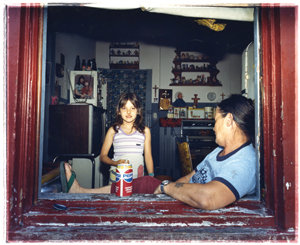
Joseph Bellows photographic gallery is located in the Art & Design Building at 7661 Girard Ave. near the intersection of Kline and Girard. To get to the “atrium” gallery you walk up a long flight of brown metal stairs, which echo under your step. The gallery at the top of the stairs is cube shaped, has white walls and wooden floors and partitioning to make for extra wall space. All around the walls 52 photographs of the current show, called “RE:view,” are positioned. There are 40 black and white photos and 12 photos in color, dating from 1960 to 1980. They are the work of 15 photographers. Bellows said that what unifies all the artists is “their ability to distill the essence of their own particular reality.” All the photographs were “mined from estate and personal archives and are previously un-exhibited or under-exhibited.” Each photo is simply numbered with a numeric push pin. You walk the gallery with a list of the titles, their dates and the author. Two basic themes emerge in this show. One theme is concerned with architecture — how we humans carve up space with cement, bricks and metal as we replace what is natural with what is man-made. Nature has beauty but so does civilization. The second theme seems to be concerned with class consciousness, with capturing images from the margins, the fringes or the periphery of society. It is a look at the marginalized, the subaltern, the other side of life, from the African American tenements in Oakland, to the carney people of traveling sideshows and circuses, to Coney Island, the graveyard shift, the shadows and litter-filled streets where drug addicts and pimps linger. There are two photographs by Bevan Davies of the New York SoHo district depicting dark, dismal, austere, forbidding and foreboding service doors and an empty storefront. Edward Sturr has two of the very best pictures, both from Chicago, in the exhibit. One is of a woman, taken from above, walking with a dog down a wet street as if in a tunnel of light in a dark city. The other is of four people ambling downstairs next to an enormous and quite beautiful brick wall. Bill Arnold offers three pictures of blurry buildings, water towers and roof top ventilation shafts in New York City. Six small pictures by Wayne Sorce from Chicago, circa 1970, adorn one side wall. They are studies of incandescent and neon lights at night. The best one is of a man standing in front of a movie theater marquee. Adjacent to those of Arnold, are two more by Bevan Davis. One is of a man standing by a burger stand, the other of two New York hippie-drug-addicts on a litter filled street. There are eight large color prints by Jack D. Teemer, Jr. from Dayton and Cincinnati, Ohio. The best, taken through a window, shows a little girl with dirt on her face looking out past her mother, who has a tattoo on her arm, causing you to ponder what it might be like for this girl to grow up in this lower class working culture. Joanne Leonard has four photographs of kids in a run-down African American neighborhood in Oakland that continue the pondering of growing up on the “wrong side of the tracks.” The best, titled “Halloween In Oakland,” shows four kids in Halloween costumes going out for trick or treating. Oscar Bailey has one panoramic piece on display of a back alley and the dirty brick buildings of lower class apartments in Chicago. Next to that are two very dark but artistic studies in contrast from John Banasiak of an empty pizza booth and a horizontal ladder set on the side of a house. Jay Boersema offers four color photographs from 1984 in Wisconsin and Minnesota of summer in a small town business district. There are two prints by Wayne Lazorik of women. One is a nude on a comforter. The other, even more intriguing, is a girl in a slip, standing by a clothesline hung with newspapers. Nacio Jan Brown offers some interesting pictures from Berkeley, dated 1969-1973, that show hippies from the love generation. Stephen Salmieri has three carny shots from Coney Island amusement venues on the verge of their demise, while Enrico Natali has a series of small photographs of people — sailors, old ladies, prom night attendees and a fashionable young woman on the streets of Detroit and New York City. Terry Wild has two photographs that are both very artistic studies of the lines of a street corner and an interior wall from Los Angeles. Randal Levenson has one very beautiful shot of a roller coaster and its neon lights just at sunset that is quite remarkable. The photographs in this exhibit are all historic, a bit dark, focused on streets, buildings and exteriors, and their relationship to people. They take a good deal of looking and attention and a bit of a connoisseurship of photography. But you come away with a better ability to look and a better appreciation for the artistic aspects of photography and so the show is worth the price you pay in concentration. The show runs through the end of July. See Joseph Bellows.com for further information.


