


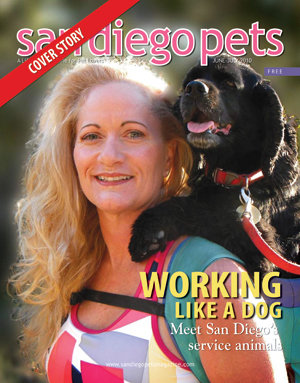
Jennifer McCallson was just 20 when her whole life changed in an instant. A college cheerleader, she was doing a back flip when she collided with a male cheerleader, shattering several vertebrae in her neck when she fell. Suddenly, she became a quadriplegic with little use of her arms. Ten years later, using a power-assisted wheelchair, she lives alone in Carlsbad with help from morning and evening caregivers. Since partnering with Sudo, her Canine Companions for Independence (CCI)-trained service dog, she enjoys greater independence, knowing that her “best buddy and cool roommate” is always with her. Sudo picks up things she drops, opens and closes doors and drawers for her and gives her a sense of security in her home. Now, as she’s learning to walk again, she feels safer knowing he is by her side. For the independent McCallson, teaming with Sudo was “a liberating experience.” Independence and security are words which crop up frequently in conversations with recipients of CCI’s assistance dogs. The dogs are their trained helpers and companions — and also their beloved pets. Point Loma resident Patty Giddings, who suffers from autoimmune disorders that weaken her entire body and render her unstable on her feet and cause her to fall, feared she could no longer live on her own. With Aberdeen now in her life, she again feels safe living alone and goes out more, knowing that if she falls, Aberdeen can help. He goes everywhere with her, carries her cell phone, sets it by her bed at night and gives it to her when Giddings needs it. As with many disabled people teaming with a service dog, Aberdeen provides a social bridge reconnecting her with the world. A former teacher who retired early on disability, Giddings said she is extremely grateful to have Aberdeen and works to raise awareness and funding so others in need can also benefit from CCI service dogs. “He’s changed my life dramatically. He’s gotten me out of my shell and is a real lifesaver. He’s brought me joy again,” Giddings said. CCI, founded in Santa Rosa in 1975, has five training locations around the country, including their southwest regional center in Oceanside near Mission San Luis Rey, which overlooks the sunny, cheerful campus. Here, a team of five instructors and two apprentice instructors train young dogs to serve in three different functions according to their traits, explained CCI spokeswoman Katie Malatino. Service dogs are larger, stronger and hard-working because they assist physically disabled people with daily tasks and are trained to open doors, turn on lights, carry packages and pull their partners in manual wheelchairs. Skilled companion dogs — which are often placed with children with autism, Down syndrome and other developmental disabilities — function as the child’s best friend and provide a connection with other children. They need to be affectionate, reliable and calm. Facility dogs, required to be friendly and extroverted, work with a facilitator to reduce stress in an educational, medical or visitation settings such as a courtroom, disabled sailing or horse therapy program. The dogs, carefully selected for temperament, trainability and physical attributes, are Labrador retrievers or golden retrievers but primarily are a cross of the two breeds, which CCI feels are best suited as assistance dogs. CCI does not use German shepherds because of genetic tendencies toward hip dysplasia. The dogs, bred specifically for CCI, are placed at eight weeks with volunteer puppy-raisers, who raise and train the puppies until the dogs are about 15 months old. Twice a month, puppies return to CCI for training. Dressed in a yellow “puppy-in-training” cape with the CCI logo, the puppies also go to work and social engagements and run errands with their puppy-raisers to prepare them for their future partner’s everyday challenges. Only about 30 to 40 percent of the dogs graduate from the program. Most are released havioral or health reasons. “We want to make sure that the type of dog we train is beneficial to the client. The (instructors) don’t believe in forcing a dog into something they’re not suited for,” Malatino said. When released, the dogs are offered first to the puppy-raisers. Other released CCI dogs are placed with public service agencies, including the Border Patrol and Immigration and Customs Enforcement, or work as search and rescue, bomb sniffing or therapy dogs. When the dogs return to CCI at 15 months, they undergo six to nine months’ intensive training, during which instructors assess their strengths, temperament and best placement. Dogs learn to focus on clients’ daily needs and to ignore distractions, such as the resident campus cat, Bob, and bunnies Stu and Zeke, who provide “distractions” for the working dogs, since many clients often have other pets. Potential clients go through a lengthy application and evaluation process lasting six months to two years, during which CCI determines whether they qualify and would be a good match for a dog. The dog and all training, support and follow-up services are provided to clients free of charge, thanks to charitable contributions. Once clients are accepted into the program, they come for a two-week residential team-training session and are matched with the dog that best suits their specific needs. Many clients use wheelchairs or other assistive devices. Apprentice instructor Becky Miller learned how to use and teach from a wheelchair as part of her own training program. “The first two weeks’ training were in a wheelchair,” Miller said. “Then, gradually, you lose more and more of your abilities to get a sense of what clients go through and why it’s important for the dogs to have certain skills. The dogs help them cope with their disabilities and save their bodies wear and tear.” Each of the dogs learns over 40 commands, with some tailored to clients’ individual needs. During team-training sessions, clients are taught how to work with and care for their dogs. CCI also provides ongoing follow-up support and advice. CCI dogs have a working life of eight to 10 years, at which time they can “retire” to become the clients’ pets, return to their original puppy-raisers or receive another retirement placement. CCI’s website and newsletters are filled with moving stories of the dogs’ power to transform the lives of their disabled partners. To watch videos of the dogs in action and to learn how to become a puppy-raiser or apply for a dog, www.cci.org. Training your own service dog Like many people with disabilities, Kimberly Ryan (cover photo) doesn’t look sick or “disabled.” On her good days, she goes to the gym and hikes. On her bad days, she can’t leave home. Her disabilities are hidden, yet her fibromyalgia/chronic fatigue autoimmune diseases affect her entire body, leaving her unable to work. She was already 100 percent disabled when she adopted Hayliegh, a black American cocker spaniel, but didn’t know her disability gave her the right to use a service dog in public. Already bonded with Hayliegh, Ryan discovered the six-month-old puppy’s special abilities one night when Hayliegh roused her from a seizure, enabling Ryan to reach the hospital. Rather than apply for an assistance dog, she decided to train the intuitive Hayliegh. Working with Aleita Downer, owner of Cape-Able-Canines, who had studied with the founder of Canine Companions for Independence (CCI) and apprenticed with Canine Support Teams, Ryan trained Hayliegh in service dog etiquette. They taught her simple commands, including “leave it alone,” “stop,” “stay” and “settle down,” which built on Hayliegh’s natural intuition, protective instincts and close bond with Ryan. Hayliegh goes everywhere with her, dressed in her vest and harness. “The doctors are amazed at what Hayliegh does for me, what she’s aware of and in tune with,” Ryan said. She credits Hayliegh with sensing the onset of debilitating migraines and autoimmune attacks and keeping her safely at home. Ryan, who developed the Hayliegh Project to share resources about service dogs and has written a manuscript about hidden disabilities, recognizes that self-training an assistance dog is not appropriate for everyone. Downer agrees that training Hayliegh was the right path for Ryan. “Hayliegh does exactly what she needs to do,” said Downer. “Training your own service dog is not as easy as it sounds. There are costs involved in training your dog and they can be substantial. Not everyone is a trainer and there is no guarantee your dog will be trained.” An organization like CCI, she said, monitors its graduates and provides ongoing support. “Sometimes the process (of self-training a service dog) itself is the success and accomplishes the goal,” Downer said. For more information about Downer’s La Mesa training programs, call (619) 463-3647, or visit www.cape-able-canines.com. — Nicole Sours Larson


