


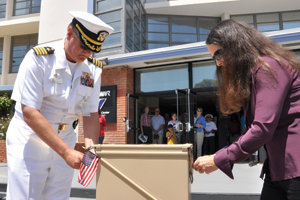
SPAWAR Systems Center (SSC) Pacific recently celebrated 70 years on Point Loma with an open-house celebration for employees, family and friends that included demonstrations of various technologies and the dedication of a time capsule. From its beginnings as a radio tower in the 1940s to becoming a leader in command, control, communications, computers, intelligence, surveillance and reconnaissance today, SSC Pacific and its various predecessor organizations have been on the leading edge of technology and providing revolutionary capability to the military. “Throughout our 70 years, we’ve been involved in tens of thousands of programs,” said Carmela Keeney, technical director at SSC Pacific, during the time capsule ceremony. “We have made many significant contributions.” She highlighted some of the early efforts, including the research and technology development that made possible the navigation of the USS Nautilus under the polar ice cap to the North Pole, the submergence of the bathyscaphe Trieste to the depths of the Marianas Trench and the design of the Polaris Missile pop-up launch system. Current efforts, Keeney said, focus on network-centric operations, including enhanced networks and communications systems, increased interoperability, networked sensors and knowledge-management tools. Mementos from the various departments highlighting some of their greatest achievements and other contributions were locked away in a time capsule during the event in an effort to preserve and honor the past 70 years. The capsule will remain locked until the centennial celebration in 2040. “The contents are unique,” said Capt. Mark Kohlheim, commanding officer of SSC Pacific, during the ceremony. “We have some current documents and artifacts. And also some archive material.” Contents include items such as unclassified briefings on today’s most advanced technologies, technical documents from various periods throughout history, photos of employees at the lab today, lanyards printed with the lab’s various names and other items. Navy officials said there is even a shorthand book published at the turn of the last century that belongs to the commanding officer’s administrative assistant. Navy officials said that though some of the great ideas of today might be looked at differently in 30 years when the items are removed from the capsule, employees and the community will be reminded of the organization’s roots, transformations and goals. If the next 30 years are anything like the past seven decades, the SSC Pacific is expected to remain an important part of Point Loma through its physical presence and economic impact.


