


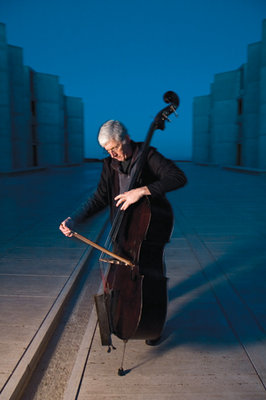
You probably have heard of smooth jazz or cool jazz or Dixieland jazz or even avant-garde jazz. But you might not have heard of “telematic jazz..” It’s the latest thing on the music scene, what jazz contrabassist Mark Dresser calls, “A new sonic reality.” Telematic jazz is actually real-time performance that is played over the Internet by musicians in different geographical locations. Because of new developments in software, a group of musicians in New York can jam along with others in San Diego without there being any noticeable time lag or delay. This opens up incredible possibilities, with the potential for any musician in the world to play along with any other, without all the complications and expense of travel, as long as a computer is available. Dresser is a pioneer of telematic music and is its biggest proponent. His first concert was in 1996 when he streamed from the Kitchen in New York City all the way to the Electronic Café in Los Angles in a jam with Bert Turketsky, his former mentor. Dresser has done about 20 telematic concerts so far, including four just this last spring. This past November, he played telematically with 30 musicians from all around the world in a concert for world peace. Dresser’s deepest hope is for telematic music to evolve to a professional status, not as a replacement for live music, but as a whole new space of music in and of itself. On June 13, Dresser orchestrated a concert of telematic jazz at the Atkinson Theatre in the Calit2 building on the University of California, San Diego campus. It was called “Respiraling: Telematic Jazz Explorations.” The title “Respiraling” comes from spiraling, a swirling movement, which is an element or metaphor in a gestural language used for composing and improvising, which Dresser calls “soundpainting.” Joining Dresser live in San Diego were Hafez Modirzadeh on saxophone, the director of the World Music and Dance Program at San Francisco State University; Michael Dressen on slide trombone, a professor of music at UC Irvine and co-founder of the Integrated Composition, Improvisation, and Technology Program there; and Alex Cline on drums, who has 35 years active experience and has played in more than 80 jazz recordings. Streaming from New York at NYU’s Steinhardt School of Music, were Amir ElSaffar on trumpet, a winner of the Carmine Caruso International Jazz Trumpet Competition; Oliver Lake on saxophone, the co-founder of The World Saxophone Quartet; Gerry Hemingway on drums, a former Guggenheim Fellow and member of the Anthony Braxton Quartet; Min Xiao Fen on the Pipa (a Chinese instrument resembling a lute), who was the first Chinese musician to play at Jazz at the Lincoln Center in New York City; and Sarah Weaver, the conductor, who works with the Arts for Peace Program at the United Nations. The stage at Atkinson Theater was set up with Dresser on bass and Cline on percussion stage right and Dressen and Modirzadeh stage left. Between them was a large screen with video feed direct from New York. There, Weaver stood in the middle, back to the audience, conducting, with Lake and ElSaffar to one side and Hemingway and Fen on the other. The evening began with a piece written by Sarah Weaver titled “Telin.” It started with slow rolls on the cymbals with bass, sax and pipa slowly blending in. The next piece, composed by Oliver Lake, was titled “As We Know It.” In this piece, percussion, horns, twangy pipa and rumbling, amplified upright bass came together well, to the accompaniment of Middle Eastern-style singing. The third piece was titled “OilEye,” which is a play on “Eye of the Oil,” which is the vortex, or where the oil flows from, at the broken well in the Gulf of Mexico. This excellent composition began with a tape of water sounds, along with drummer Hemingway sawing the cymbals with a violin bow. Oliver Lake chimed in with a wonderful beat poem in the Jerome Rothenberg style and then took up his horn to twist and tweak out an incredible sax solo that would rival John Coltrane. The last composition of the evening, called “Tele Whorl,” was written by Dresser. It began with Dresser swirling his arms around and around in spiral after spiral thus leading the musicians into action. Toward the end of this piece, Dresser turned the swirling over to Weaver, and really got down to some serious jazz bass playing. All told, it was a wonderful evening with an elaborate, intricate and highly-varied tapestry of strange and exotic sounds. For information on upcoming concerts see MarkDresser.com.


