


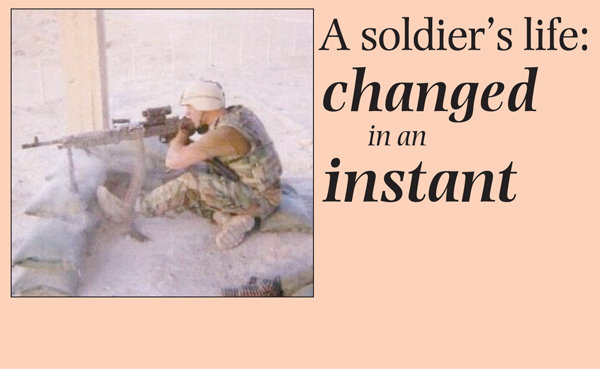
Iraq War veteran Tristan Wyatt found something he was truly passionate about in the U.S. Army — a career he would have pursued had it not been for a debilitating injury near the start of the war in 2003. “I don’t really know what it was about that job, or maybe even being in combat, that was just appealing to me,” he said. “I wanted to stay in for as long as I could because I loved what I was doing.” After high school, Wyatt joined because he said he felt compelled to serve his country following the 9/11 attacks. “I think I would have felt guilty if I didn’t do it for some reason,” he said. In August 2003, just months after the invasion of Iraq, the best career Wyatt could have imagined was abruptly halted in a single incident. The then-21-year-old soldier was conducting route reconnaissance in Fallujah when his unit was ambushed by 30 to 40 insurgents who emerged from trenches on both sides of the road. “They were everywhere. It was crazy,” he said. “It was instantaneous. We just immediately engaged the guys on the left-hand side.” A sudden firefight ensued, and just as Wyatt maneuvered to gain a better position, a team of insurgents snuck behind him and fired a Light Anti-Tank Weapon (LAW) — a powerful rocket-propelled grenade designed to penetrate heavy tank armor — striking Wyatt in his right knee and taking his leg clear off. The projectile continued on through two more of his fellow soldiers, who were taken down with him. “We actually had to duke it out with them a little bit longer after we got hurt, just so they would start to retreat,” he said. After six months of treatment and therapy at Walter Reed Medical Center in Washington D.C., he was finally released home to Colorado where he spent another six months with friends and family, wondering what his next move would be. “There were a ton of transitional people trying to get acclimatized to the civilian world,” he said. “They had suggested an internship at the VA, but at the time, there were other things that I wanted to do.” Wyatt said the most difficult part of the transition was not necessarily losing his limb, but having something he loved to do ripped away from him so quickly. “My biggest thing was that I had found something that I had attached to — something that resonated with me as an individual — and I wanted to do that for a long time. So to have something that you connect with on a deeper level, and then have it literally torn away from you in the same year is kind of difficult to deal with,” he said. “Given the circumstances, I was really lucky to even get out of there alive. I recognized that immediately, but it was that I really found something I liked to do and now the things that I want to do professionally I can’t, so you just have to come to terms with that.” Finally, Wyatt, now 29, took an internship at the same D.C.-based army medical center that treated him, which eventually turned into a career and a move to San Diego to work in the prosthetics department at the San Diego VA Medical Center in La Jolla. “You can get [any prosthetic] that’s commercially available at the VA,” he said. Wyatt was even recently fitted with a state-of-the-art microprocessor knee that only the Department of Defense and VA can obtain. “It’s basically the newest technology — a later generation of what I have now,” he said. “It’s an upgraded version so I’ll be able to walk up stairs normally and the gait’s a lot smoother.” The best thing about the upgrade? It’s waterproof — a necessary requirement for one of Wyatt’s new hobbies: rowing. “It’s not as limiting as you would think, but you have to have a heart-to-heart with yourself about stuff you can and can’t do, or things that maybe have become such a pain now that you’ve decided to move on,” he said. As a Colorado native, Wyatt said he used to enjoy snowboarding because it was such a “free experience.” “You could just pick your board up, go up on the mountain, and forget about everything that’s going on,” he said. “I can still do it, but it’s such a pain to actually do it. You need extra equipment, and it’s not the same feeling as it used to be.” The injury, he said, has forced him to find other things to do. He has recently picked up rowing in Mission Bay and four-wheeling in jeeps — activities he said he never would have considered if he hadn’t gotten hurt. Despite the injury and changes to his lifelong plans, Wyatt remains positive and said he realizes he was lucky to make it out of the situation alive. At times, however, he wishes he were still able to continue fighting for his country. Veteran’s Day, Wyatt said, cements how good this country is to soldiers returning from war. “Ever since I’ve been home, I’ve been treated so well by everybody,” he said. “It would be very difficult for me to feel bad about anything that has happened to me knowing that these are the kinds of people I was fighting for.”


