


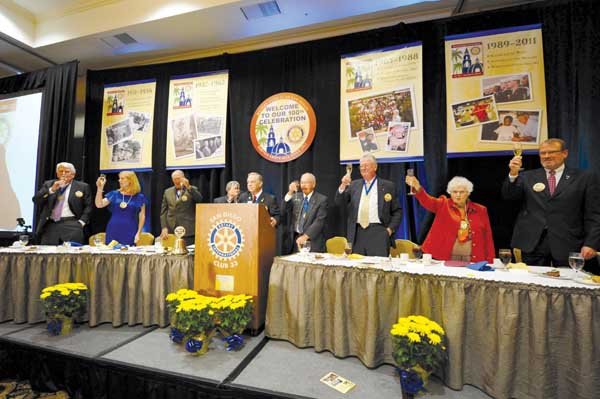
Rotary Club 33, San Diego’s chapter of the international service organization, began 100 years ago at the newly minted U.S. Grant Hotel. The club would eventually become one of the organization’s five largest worldwide chapters, with 550 members. Seventy five years later, women were allowed to cross the threshold and join businessmen and San Diego movers and shakers as Rotarians. Natasha Josefowitz, Ph.D., who taught the first college course in the United States on women in management and who is the author of 19 books (as well as a La Jolla Village News columnist), was among the first five women to enter the Rotary when it finally offered membership to the “fairer sex.” Josefowitz caught the eye of the Rotary when she was asked to give a presentation at one of its luncheons 25 years ago. She had recently published her bestseller, “Path to Power: A Woman’s Guide from First Job to Top Executive” and had given interviews on “Larry King Live” and the?”Dr. Ruth Show,” among others, and the local Rotary club wanted to hear her speak. She spoke on issues of women in power, and received more than a few heckles and off-color jokes from the audience. Her message, however, was heard loud and clear. The club asked her to join as its first female member shortly after. Josefowitz responded with a flat-out “no.” “It was an old boys’ club,” she said. “I didn’t want to be the only woman in there.” Eventually, Josefowitz caved and told the club that if they could muster up four more women, she would join. It became clear, however, that truly welcoming women into the organization would take more than a simple invitation. “At first, when I would sit alone at a table of all men, they would say, ‘Oh, a rose amongst the thorns,’” she said. “And if [all five women] would sit together at a table, they would say, ‘What are you plotting?’” The San Diego chapter, however, proved to be much more accomodating than clubs in other places, Josefowitz said. Some clubs lost male members once women were allowed to join. And as for Rotary Club 33, the atmosphere in the club has decidedly changed in the quarter-century since women first joined its ranks. Now, Josefowitz said, women not only make up a quarter of the membership, they are leading more than a quarter of the club’s various committees, and some have served as the club’s president. Have the club’s goals and services changed with the inclusion of women? Perhaps, Josefowitz said. “It seems that everyone, not just the women, have become more hands on,” she said. “We don’t just write checks. And I?think it’s more family-oriented now than it was, and a lot of our committees focus on youth and family.” As for relations between the male and female members, Josefowitz said the “old boys’ club” is no longer. “All the members are highly educated and work at high levels of business,” she said. “So the men have this opportunity to work with really bright women. It has cleaned up fairly well, and we don’t see those off-color jokes anymore.”


