


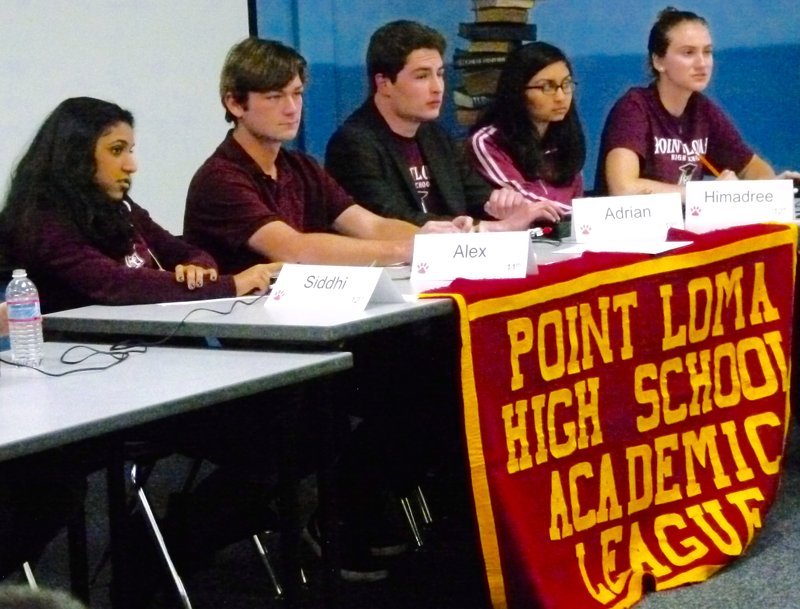
Some of the most skilled students competing for Point Loma High School don’t catch a football, hit a baseball or kick a soccer ball, yet they can earn a school letter. There are no uniforms, referees or whistles. And unfortunately, few fans watch. Their scores aren’t reported in local media, and there are no lucrative college scholarships available for its stars. In fact, these students sit at a desk, using only the organ located between their ears to pile up points against the best students other schools can muster. Welcome to the Academic League, where participants get nervous, perspire and experience stress during competition, much like their athletic counterparts. The Pointers have fielded Academic League teams for about two decades, and the program is currently run under the auspices of the National Academic Quiz Tournament, a 20-year-old organization that has standardized competition from middle-school to college level. The national group also organizes state tournaments leading to a national champion. Last year’s national tournament drew 272 teams who battled through 26 rounds before a champion was crowned. This year’s finals will be held in Dallas from May 27 to 29. Last week, the Pointers Academic League team hosted Madison High in the school’s Media Center for the season’s first match. Each school fields three teams: novice (9th and 10th graders who play a 20-minute match); Junior Varsity (10th and 11th, 25 minutes) and Varsity (11th and 12th, 30 minutes). Questions are mailed to moderators in advance for secrecy and reflect the knowledge in all subject areas ideally gained by students at each level. However varsity also includes some pop culture questions. With no help available, team members hustled about the venue, moving tables and five chairs into place for each side’s contestants, arranging chairs for audience members and positioning a podium for the moderator and even a table for snacks and bottled water, donated by Einstein Brothers Bagels and Baron’s Market. Also set in front of each player was a “lockout” button system to identify the first person to push the button. Students set up and tested this system. Before each match, a member of each team spoke, welcoming the audience, thanking the moderator and introducing the other four teammates at each five-person table. Competition flows quickly, with simple rules. The moderator reads a 10-point “tossup” question, and a student monitor and timekeeper stationed between the team tables announce the school and name of the first student to activate the button. A correct answer within 3 seconds is awarded by three more 10-point “bonus” questions, usually on differing topics. Questions requiring computation are given an extra 10 seconds. And the questions aren’t exactly popcorn balls. “Part of this desert,” one may read, “is not arid enough to qualify as a desert, but it is known for its red sand and large game reserves and mineral deposits, most of which is uranium.” If you answered the Kalahari Desert, take a gold star. “This Broadway hit,” according to another, “tells the story of Buffalo Bill’s Wild West Show when it comes to town and performer Frank Butler challenges anyone to a shooting contest that is won by a local woman named Annie.” The question’s sort of a giveaway, but “Annie Get Your Gun” is correct. The only penalties given are five-point deductions when an incorrect tossup answer is given before the question is completely read. The other team may then answer for a net 15 points. Team advisors may call a time out at any time, stopping the clock, to replace any of their five seated players. In the Varsity match, the Pointers started strong and never looked back, scoring a decisive 350-235 victory. Later, a relieved second-year team Capt. Adrian Burnes, a senior in his fourth year of competition, shared his thoughts. “I’ve improved considerably since my freshman year,” Burnes said. “through experience and the example of my upperclassmen.” Burnes noted he specializes in the areas of history, geography and the liberal arts in general, although he quickly computed and answered several mathematics questions to earn points. “I’m very scared, I stutter a lot. It’s very stressful for me,” Burnes revealed, “but it’s very fun and exciting as well.” Do others become upset when a teammate gives a wrong answer? “We don’t put them down,” Burnes said. “We encourage them and say ‘You’ll do better next time,’ and we believe that.” Last year, the Pointers won their region but lost to eventual champion La Jolla in the first round of the county championships. All members who answer a question at the Varsity level receive a school letter matching those in athletics and band. A patch on the letter denotes Academic League. Practices for the team are held twice a week during the short 30-minute student lunch period in the classroom of fourth-season faculty advisor James Ballantine, a biology and advanced biology teacher. “The kids are so enthusiastic and interested in doing well that it’s not difficult,” said Ballantine after the match. “They come in and set up the buzzers. Sometimes they’ll get in a debate about a topic, but generally, they run it and seem to love it. They set up and clean up, and I see my role more as a collaborator.” Ballantine has made subtle changes since his first year as advisor. “I start in September now,” he said, “because if I don’t, the kids get involved in all kinds of sports and clubs. I learned I couldn’t start after Halloween or Thanksgiving.” Questions used for practice sessions can be purchased from the national organization or come from a collection written by other advisors. Academic League is under the Office of Advanced Studies in the San Diego Unified School District, where three separate regions that have been identified, including several private schools. “I think Academic League can make a big difference in some kids’ lives,” Ballantine said. “Some of them may be athletes, but many of them aren’t, and it’s another part of life where they can really excel in academics, where they can learn and really be proud of it.” And what should younger students do to prepare themselves for eventual membership on the PLHS team? “Read books, read academic stuff and talk to intelligent people,” Burnes suggested.


