


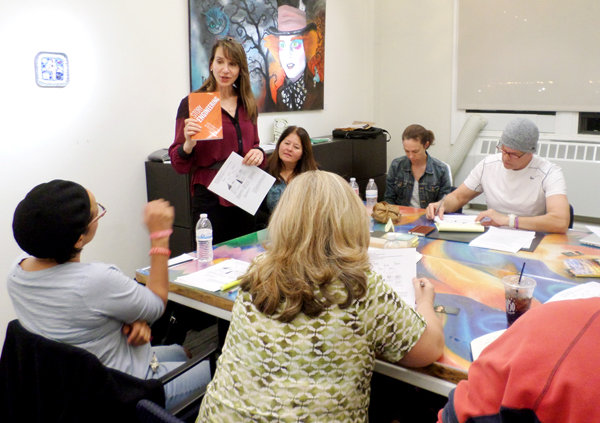
Self-publishing and the independent publishing marketplace make it more possible for writers to get their memoirs to market. For this reason, San Diego Writers Ink has held many memoir classes and courses – and last month enthusiastic writers attended the class run by Trish Wilkensen and Howard Shulman. Wilkensen says that people of all age ranges want to write memoirs. Usually, they are people who have been through some kind of adversity they’ve overcome. “They take all kinds of steps to grow inside as well as outside, and then they want to share it with other people and hopefully have other people benefit from their experience,” Wilkensen says. Gerald Frazier attended the course, and he has already written a memoir called “The Dawn Phenomenon,” about his battle with diabetes. He says he wants to write to fulfill a moral duty. When one has information that will help others, he says, that person has a moral obligation to make that information available to as many people as possible. “I want to get the writing knowledge I can absorb, and that’s why I find writing groups like San Diego Writers Ink so helpful,” he notes. Wilkensen says that people at the class seem enthusiastic but that they don’t know yet that writing a book is daunting. Wilkensen tries to make it simple, saying, “Write a page a day.” “If you do that, you have your first draft in a year,” she says, “which makes it doable. I also give them a story frame to put the story in order so that they can look at their whole story on one page and say that’s it’s not impossible.” She says that when a person wants to write a memoir, the first step is just decide that you are willing to be honest and share the truth. “To write my first book took me about three years,” Frazier says. “The first three chapters took me one year, then it got easier for the rest of the 19 chapters. Hopefully, my second book won’t take as long.” His book is set in the beginning of the fall of 2011, when he learned he had diabetes, through the spring of 2014, upon his graduation from The Institute for Integrative Nutrition, the world’s largest nutrition school. “I discovered the medical term for an ancient survival mechanism, The Dawn Phenomenon, and a new paradigm for health care,” he says. “Our current medical system is corrupt and many times counterproductive to our health.” Frazier thinks the writing was fun. He says he wanted to engage the reader’s right brain with humor and art and then switch back to facts and figures and left-brain logic. Specifically, he says, people with health problems can benefit from his book. “All the M.D. is trained to do,”: he says, “is to treat your symptoms with a poison or a knife. Doctors receive little to no training in nutrition, even though Hippocrates, the father of medicine said, let your medicine be your food and let your food be your medicine.”
He cautions that everyone is different and that what worked for him may not work for the reader.
“I cannot claim to cure or even to mitigate any disease,” he says. “I must avoid prescribing any substance. I must advise the reader to check with his own medical professional before taking any action based upon any information in my book.”
Frazier is writing a second version of “The Dawn Phenomenon.” He says there is new research resulting in new discoveries, research that was not available when he wrote the first version.
He advises memoir writers to write constantly.
“Set aside 30 minutes per day to read and write,” he says. “Practice ‘morning pages’ where you write in the morning before you wake up. You are in the twilight of unconsciousness and semiconsciousness, in touch both with yourself and with the great storehouse of knowledge that circles our globe.” For more on San Diego Writers Ink, see sandiegowriters.org.


