


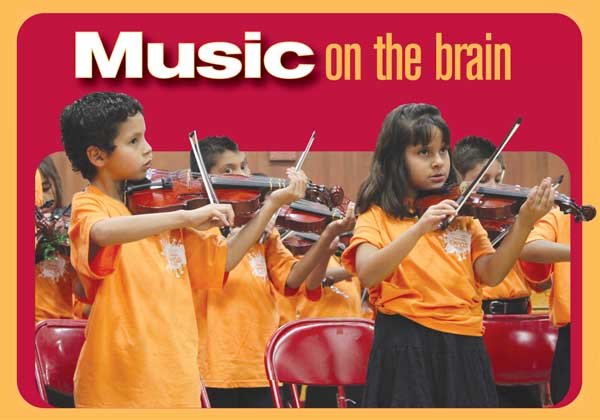
A new research partnership is bringing three unlikely worlds together for a common cause. The collaboration will pull together music, science and martial arts in the hope of shedding light on brain development in children. Pooling the resources of the Neurosciences Institute, UC San Diego’s Center for Human Development and the San Diego Youth Symphony and Conservatory (SDYS), the study aims to answer how musical and martial arts training influence the development of cognitive skills like language, attention, and spatial reasoning. “There’s been longstanding anecdotal evidence of the influence of musical instruments on cognitive development, but there’s only a limited amount of rigorous exploration of these questions,” said Dalouge Smith, president and CEO of SDYS. “This will be an attempt to see if what has been anecdotally observed can be identified through testing and research models.” The study will recruit about 120 children, split into three groups: one consisting of music students, another of martial arts students and a third control group. Over five years, the study will observe how the students’ brains are affected by their respective activity through once-per-year assessments that involve a brain scan and a series of cognitive tests. “By the end of five years,” Smith said, “ideally we’ll be able to differentiate the factors that have been influenced by music or martial arts.” Though the idea that the brain is influenced by music is not a new hypothesis, researchers are hoping to cover all their bases by introducing the martial arts angle. That way, Smith said, results should be more conclusive as to which activity affects the brain and in what ways. “We didn’t want to suppose that long-term participation in music was having all of these effects, while not knowing if similar long-term participation in another physical activity that requires a continuous pathway of improvement would have a similar outcome,” he said. “Here, we can determine if those effects are from any activity, and what seems to be the result of long-term activity in general, as compared to music, as compared to martial arts.” The effects of music and other activities on the brain are intriguing to be sure, but that’s not the only reason Smith and the SDYS were eager to jump on board. What with cuts to music education in recent years, this study, Smith hopes, will help show policy makers just what we’re missing by reducing such programs. “[SDYS has] a long history of seeing high achievement in all areas with our students,” he said. “Our students go off to top universities, and we have a strong interest in better understanding of what’s underpinning that. We’ll be able to potentially use evidence like this to talk about the benefits of music education for a child’s development and build community support for music education.”


