


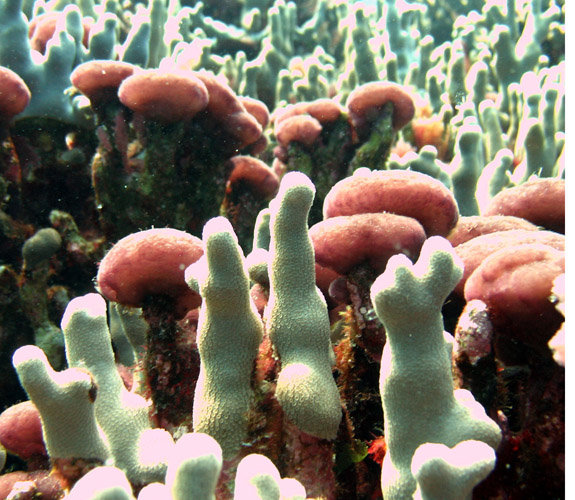
In 2008, researchers discovered an organism on the coral reefs off the Kona coast of Hawaii — one of the islands’ most popular diving sites. Determined to be a type of seaweed bloom, the organism concerned scientists as it was clearly smothering — and in some cases, bleaching — the delicate reefs. Soon thereafter, samples of the offending seaweed were sent to UCSD’s Scripps Institution of Oceanography for analysis. Led by postdoctoral researcher Hyukjae Choi, a team of scientists in William Gerwick’s laboratory at Scripps examined the samples. What they discovered about the seaweed, a photosynthetic organism known as cyanobacterium, was truly surprising. Cyanobacterium, while considered a nuisance to the coral reefs and those that dive near them, could actually provide a much-needed relief for skin conditions and inflammation. The seaweed, researchers found, produces chemical compounds that exhibit promise as anti-inflammatory agents and in combating bacterial infections. Known as honaucins, the compounds hamper bacteria’s ability to “swarm” over surfaces. Bacteria, the researchers reported in their study, published in Chemistry & Biology on May 25, secrete small amounts of a substance known as a quorum sensing factor, which tests to see if a new surface is safe for colonization. By halting that process, the substances found in the seaweed could one day translate to a treatment for bacterial infections. “In different arenas these compounds could be helpful, such as treating chronic inflammatory conditions for which we currently don’t have really good medicines,” said Gerwick, a professor of oceanography and pharmaceutical sciences at the Center for Marine Biotechnology and Biomedicine at Scripps and UC San Diego Skaggs School of Pharmacy and Pharmaceutical Sciences. The findings could be critical, Gerwick said, in the development of drugs to prevent infection, for example, in patients who require catheters to deliver vital nutrients to key areas such as arteries, as well the development of new treatments for acne and other skin conditions. “I think this finding is a nice illustration of how we need to look more deeply in our environment because even nuisance pests, as it turns out, are not just pests,” said Gerwick. “It’s a long road to go from this early-stage discovery to application in the clinic but it’s the only road if we want new and more efficacious medicines.” The discovery, said assistant professor and study coauthor Jennifer Smith, demonstrates the potential for naturally occurring organisms to yield, in some cases, life-saving properties. “These organisms have been on the planet for millions of years and so it is not surprising that they have evolved numerous strategies for competing with neighboring species, including chemical warfare,” Smith said. “Several species of cyanobacteria and algae are known to produce novel compounds, many that have promising use in drug development for human and other uses.”


